


New UMMC food pantry to be available to students
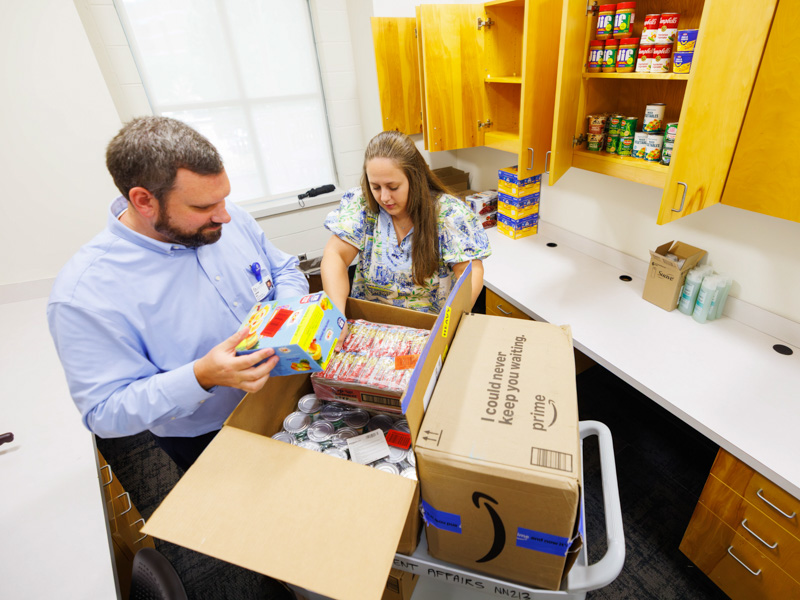
As the academic year begins across the University of Mississippi Medical Center’s schools, the Office of Student Affairs and Office of Academic Affairs are launching a new initiative designed to help students succeed both inside and outside the classroom.
Beginning Sept. 1, the Student Union Food Pantry will provide free access to nonperishable food and essential personal care items for students experiencing food insecurity. Located on the second floor of the Norman C. Nelson Student Union, the pantry will be available to all UMMC students.
Dr. Jonathan Nutt, director of student services, said the pantry was created to address a need that can easily go unnoticed.

“I think many people just assume our students are good because they are going to medical school or nursing school, but every student’s situation is different,” Nutt said. “Some students have strong family support, while for others, earning this degree is a dream they’re working incredibly hard to achieve. Every financial situation is different. Not every student here will need a food pantry, but for some, it can make a real difference.”
Food insecurity among college students is not unique to UMMC. According to the National Center for Education Statistics at the U.S. Department of Education, colleges and universities across the country serve undergraduate and graduate students experiencing food insecurity and homelessness. Nationally, 23 percent of undergraduate students and 12 percent of graduate students experience food insecurity. Among medical students, research has found that 21.2 percent — about one in five — have experienced food insecurity.
For UMMC leaders, addressing those basic needs is part of supporting students throughout their education.
Dr. Scott Rodgers, associate vice chancellor for academic affairs, said the pantry represents UMMC’s commitment to investing in the people who learn, work and receive care at the Medical Center.

“The Food Pantry is a priority simply because we want our students to be fully supported, to the greatest extent possible, during their time with us at UMMC,” Rodgers said. “Students often take on a great deal of debt for their education, and this debt adds to the stress they experience as they go through their training. If we can remove a small portion of that stress through the Student Food Pantry, then the effort is entirely worthwhile. Our students at UMMC represent one of Mississippi’s brightest hopes, and we are proud of them and deeply committed to their success. I hope folks across UMMC choose to support the Student Food Pantry and all of the good that it will bring.”
To prepare for the pantry’s opening, the Office of Student Affairs is hosting a campuswide food drive to stock its shelves. Organizers are collecting nonperishable food and personal care items, including canned vegetables, fruit cups, applesauce, microwavable rice, cereal, crackers, peanut butter, ramen noodles, macaroni and cheese, granola bars, soap, shampoo, conditioner and deodorant. Community members can also purchase needed items through an Amazon wish list or drop off items at the Rowland Medical Library or in the Office of Student Affairs near the Student Union.
Nutt said this will be UMMC’s first food pantry dedicated exclusively to students. Before launching the initiative, the Office of Student Affairs researched similar programs at other Mississippi Institutions of Higher Learning to identify best practices.
“Every other IHL institution — the University of Mississippi, Mississippi State University, Alcorn State University, Delta State University, Mississippi State University for Women, Mississippi Valley State University, the University of Southern Mississippi and Jackson State University — has some version of a food pantry,” Nutt said. “They all look a little different, but we’re excited to bring one to UMMC.”
Beyond providing food and personal care items, Nutt hopes the pantry will help reduce the stigma surrounding food insecurity and make students more comfortable seeking assistance when they need it.
“We’ve had students tell us they weren’t sure how they were going to buy their next bottle of shampoo or other basic necessities,” he said.
Students will not be required to complete an application or go through a lengthy approval process to use the pantry. Information about operating hours and access will be shared with students ahead of its Sept. 1 opening.
Looking ahead, Nutt hopes to establish partnerships with food manufacturers and community organizations to expand the pantry’s offerings. For now, he is encouraging the UMMC community to help stock the shelves by donating needed items or volunteering through the Office of Student Affairs.
For Rodgers, even a small contribution toward meeting students’ basic needs can help them focus on the reason they came to UMMC in the first place — preparing for careers that will ultimately serve the health needs of Mississippi.