


‘This has pulled us together’: UMMC prioritizes care, learning during cyberattack
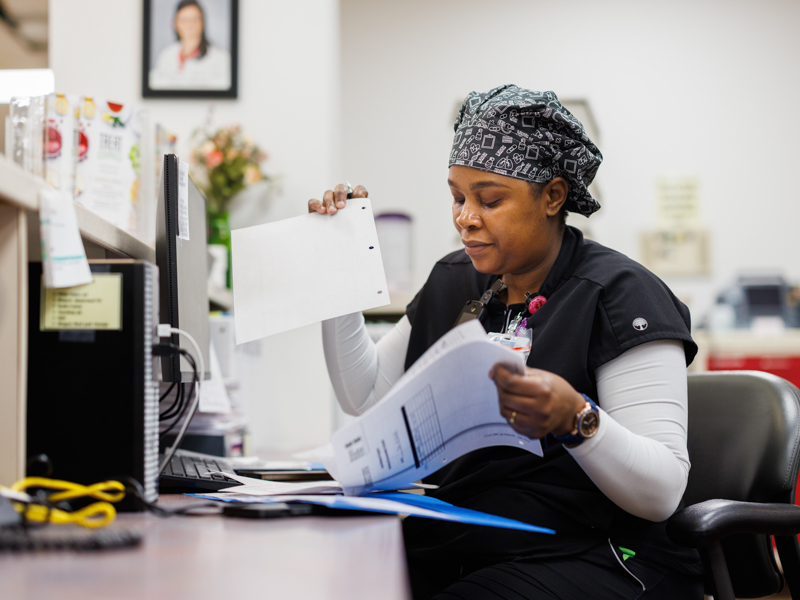
The University of Mississippi Medical Center’s clinics resumed normal operations today following a nine-day ordeal caused by a cyberattack. While all mission areas were impacted by the criminal intrusion, the patient care mission was disproportionately affected. As the Division of Information Systems worked around the clock to bring the network back online, medical teams worked to ensure continuity of high-quality care.
The following are some glimpses behind the scenes of health care delivery during a crisis.
CCRI
The computer screens were dark at the nurses’ station inside the infusion space of the Cancer Center and Research Institute at the University of Mississippi Medical Center, but there was a hum of activity next door.
Inside the Hardy Clinical Sciences Building, a conference room was turned into a command center where care team members reviewed patients’ charts and discussed conditions. Their focus was on how to restart care in a temporary analog environment.

“Over the past few days, we have witnessed something that I will carry with me for the rest of my career,” said Dr. Devika Das, director of the UMMC Division of Hematology and Oncology and CCRI associate director of clinical affairs. “Within hours, nursing, pharmacy, physicians, nurse practitioners, lab technicians, social workers, navigators and administrative leaders came together and built a war room, a true command center. We pivoted from high-tech to paper charts.
“We created a fully functional, urgent infusion clinic operating entirely offline. We found smart, secure ways to access critical vendor data. We reimagined workflows in real time. We solved problems we never anticipated facing. There was no complaining. No ego. Just a unified mission: keep our patients safe. Keep critical cancer care going. Protect the most vulnerable among us.”
In the infusion space inside the UMMC Medical Pavilion, Ora Davis of Canton was receiving an infusion treatment for pancreatic cancer.
“I was scheduled to come in Thursday (Feb. 19, the day of the cyberattack), so I appreciate them calling and rescheduling me,” she said.
When UMMC’s clinics closed Feb. 19, CCRI restarted chemotherapy Feb. 23 and worked to increase the number of patients during the week.
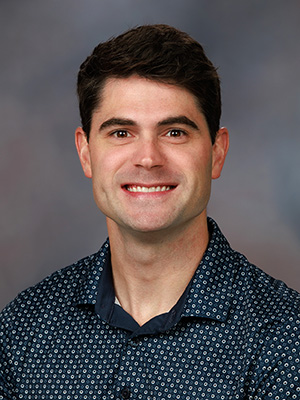
“This cyberattack is a nightmare, but we’re handling it with a smile,” said Andrew Shelby, business manager of the UMMC Division of Hematology and Oncology. “We’re making it happen.”
Das said, post-cyberattack, UMMC is stronger. “We were, quite literally, trauma bonding, and in that bonding, I see something powerful forming. We are stronger, more connected and have discovered the heart of medicine that exists beyond computers, systems and infrastructure. We are emerging from this crisis with lessons, innovations and teamwork.”
During the week of network system downtime, staff contacted patients in need of urgent care to schedule clinic visits. Hospitals and emergency departments remained open throughout the response to the cyberattack, allowing health care professionals to provide services Mississippians expect.
Children’s of Mississippi
Teams at Children’s of Mississippi quickly shifted into crisis response mode.
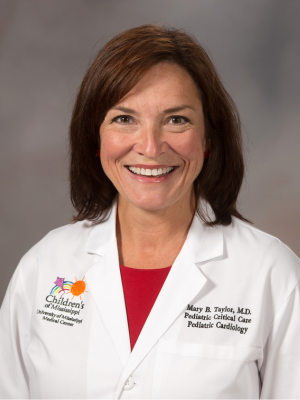
“The response from our Children’s teams has been remarkable,” said Dr. Mary Taylor, Suzan B. Thames Chair of Pediatrics and CEO of Children’s of Mississippi. “Even under the stress of a cyberattack, our staff showed incredible collaboration and dedication, making sure every child and family received the care they needed without interruption.”
For Olivia Ulbrich, project manager for Child Life, that meant stepping into a critical coordination role to help ensure there was no lapse in patient care.
After leaders met overnight to determine supply needs, materials began arriving on campus. What was needed next was a central location and someone to manage it.
“The directors and leaders got together Thursday night, determined what they needed to order and then placed the order,” Ulbrich said. “Items started showing up, and they needed a point person and a location, so that’s how this room came to be.”
A makeshift document and supply center was created to serve both adult and pediatric units, and Ulbrich stepped up to serve as the point person for Children’s. She spent her Saturday organizing the space, receiving and sorting deliveries and distributing essential paperwork and supplies to units across the hospital.
Despite the disruption, Ulbrich said the response across the hospital was marked by teamwork. Physicians stepped in to assist nursing staff. Residents helped organize materials and streamline communication between units. Staff members without immediate assignments showed up asking how they could help.
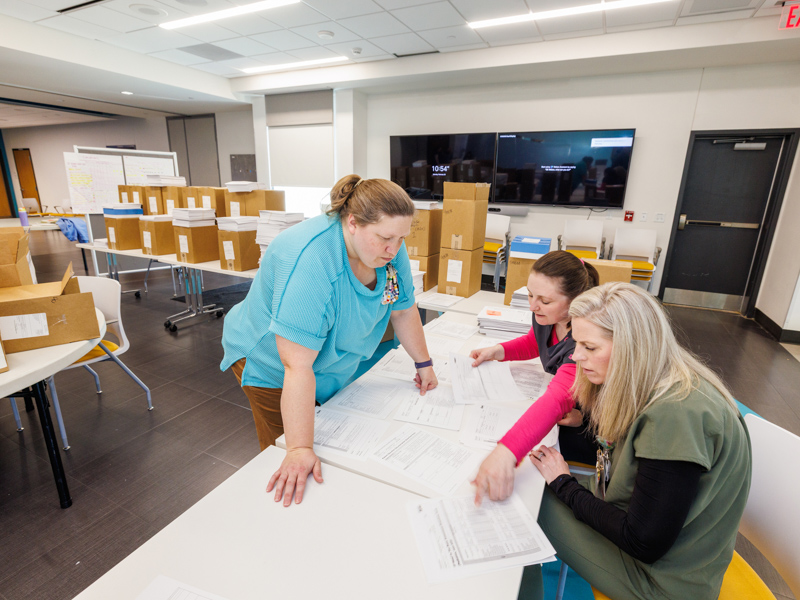
“Some people who didn’t have an immediate responsibility were just showing up and saying, ‘How can I help?’” she said. “There’s been a lot of communication, even physicians going to nursing and asking how they can help.”
Ulbrich said the collaboration helped steady teams during an uncertain time.
“Everybody’s coming together and pitching in,” she said. “I think, in a way, it’s boosted morale. It’s a very fluid situation, and it is stressful, but people are coming together to do something.”
Nursing
At Wiser Tower, the pivot to paper for charting patients in obstetrics and gynecology ramped up over the weekend of Feb. 21-22 on its 29-bed fifth floor.
Ordinarily, Jill Cutrer, nurse manager, and her team dutifully care for patients with all the technology included with modern health care.
But with no network, they worked feverishly to recreate physically what can be seen these days only digitally. For starters, they took an old mailbox out of a locker and repurposed it for holding clinical documentation, such as vital sign sheets and clinical lab forms.
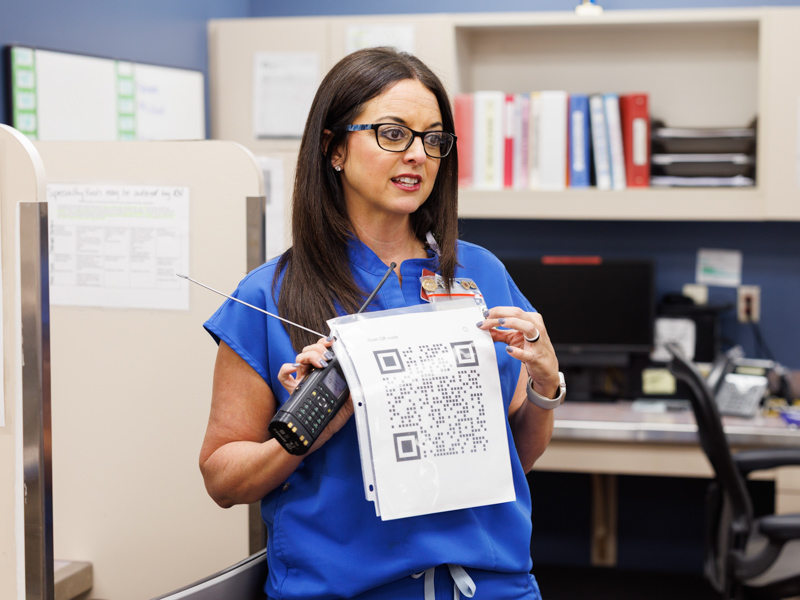
“We made it easy for our nurses to come and pull sheets they need to add to their clinical documentation,” Cutrer said. “That includes the forms we have that show every order the doctor writes and that we gave that medicine. We were writing all of those by hand.”
Charts for each patient on the floor were put into binders to start the week. When orders were changed, they were simply flipped upward. Nurses then verified the orders and noted when they were completed.
Prescriptions were double-checked manually for accuracy and accessibility by the unit’s pharmacist, Laura Latham.
The “complete change” from computer to paper documentation meant getting more hands on deck to help do it. It was quite a teaching moment for Cutrer, a 16-year nurse at the Medical Center.
“It was a re-education, but our nurses know what they’re doing,” Cutrer said. “A few of them have seen this while they were in school, so they were familiar with how we do this.
“We have relied on our experienced nurses to help with the parts of this process for nurses who have never documented on paper before. Our quality nurses and unit educators have made sure we know how to document the care we’re providing to the patients.”
University Hospital
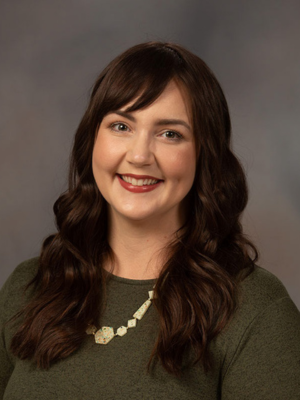
Kim Barrier, director of UMMC’s Nursing Quality and Patient Safety for Adult Hospital Nursing Administration, said it has been nearly 15 years since anyone has done manual charting for an extended period without an electronic medical records system.
“For much of today’s nursing workforce, paper charting is unfamiliar territory,” Barrier said, noting that normal auditing and surveillance functions are temporarily suspended as quality and safety efforts focus on detailed patient care and supporting frontline staff as they adjust to the changes.
“Weekends and nights – we’ve been through it all. Communication is the biggest challenge because we’re not able to talk through our normal channels. For example, we can’t share documents through Microsoft Teams.”
She added, “We have to run around to get papers copied. A colleague just ran down five flights of stairs to get one piece of paper to add to our pile to make sure we have everything we need.
We’ve had to hardwire our computers directly into printers in some areas. And we’re trying to make sure we’re sending originals to our external printing team so we’re not dealing with copies of copies.”
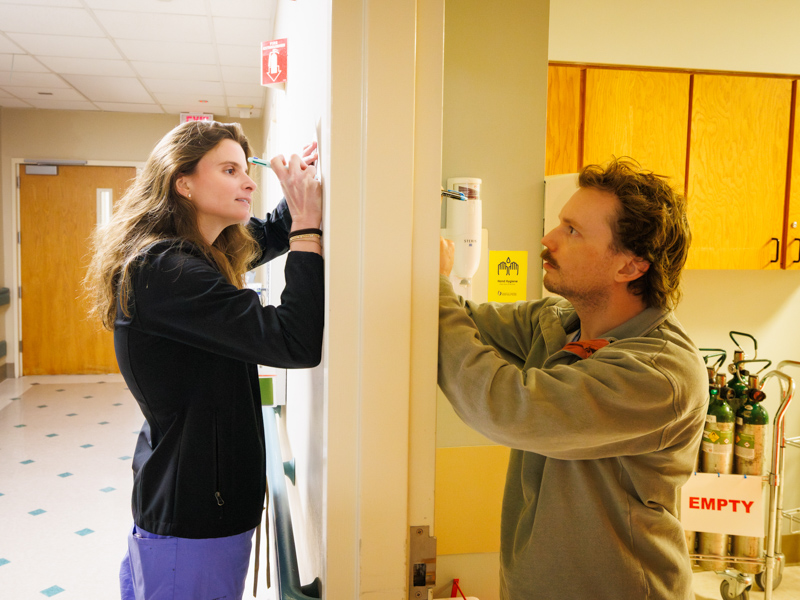
Heather Pierce, director of Nursing Excellence, said ambulatory teams are communicating with outpatient populations.
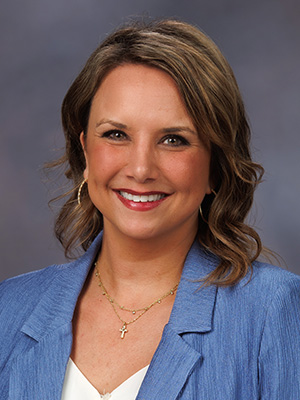
“Every part of patient care is affected by this. But patients are still receiving great care,” Pierce said.
UMMC had downtime procedures in place. However, Barrier said the cyber attack has underscored how critical it is to prepare for large-scale, extended outages and to continuously refine contingency plans.
“I think this helps us realize how important it is to prepare for downtime and not take it lightly,” Barrier said.
Despite the long hours, the team continued to lean on one another.
“We’re good,” Barrier added. “We’re just helping each other, picking each other up and doing whatever task is needed in the moment.”
When asked what else has required adjustment, the answer was immediate — and physical.
“Everybody’s hands are cramping from writing.”
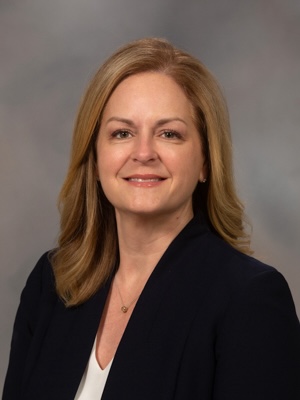
Nevertheless, nursing leaders are confident that while systems will return, the lessons about resilience, communication, preparation and teamwork will remain.
“Our teams have come together in an incredible way to keep the Medical Center running,” said Dodie McElmurray, CEO of University and community hospitals. “They’ve worked very hard to ensure every patient continues to receive the same high-quality care they expect from us. Patients can be confident that their care has remained our top priority.”
Stress relief
Carts loaded down with relief devices and other goodies rolled through the hallways of the Medical Center and Children’s of Mississippi like an encore of Mardi Gras for staff coping without a functioning computer network.
“We bring out the physical therapies like the stress balls and fidget spinners as well as snacks to support employees when they’re out of their comfort zone in times like this,” said Samantha Smith, social worker in the Office of Well-being.
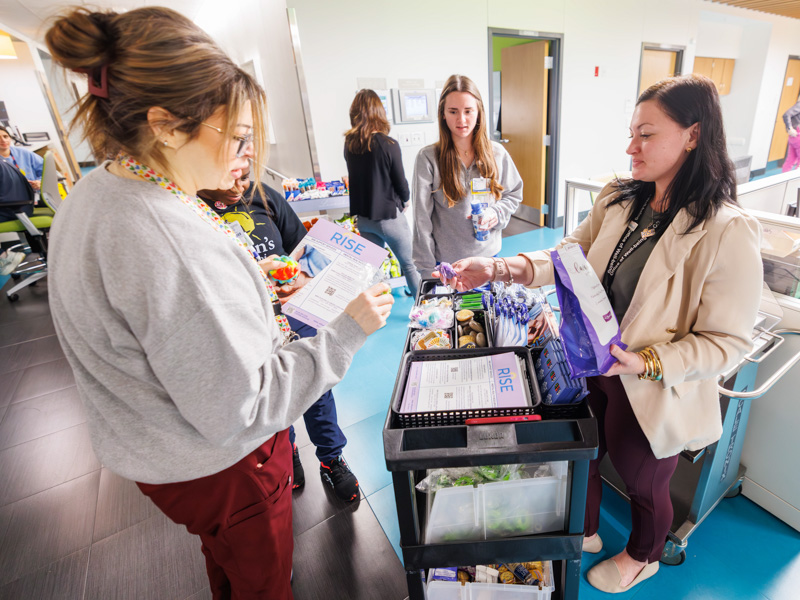
The Lavender Carts are part of the office’s Resilience in Stressful Events program, which offers mental health and resilience resources in the form of peer support and crisis intervention.
Meagan Murphey, an inpatient nurse at Children’s, was among those who scooped up a stress ball and other items that soak up anxious energy.
“Oh my God, I need that!” Murphey said while grabbing one of the squishy manipulatives off the cart. “I use them with my son at home. I use them on the job here.”
School of Medicine
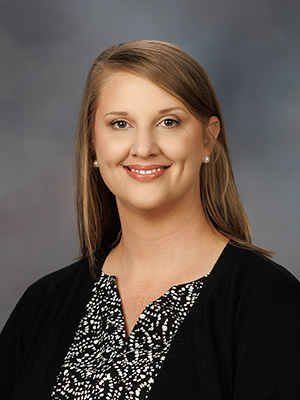
“No one has had the mindset of, ‘oh, we get free time off,’’’ said Leah Stanford, instructional designer in the UMMC School of Medicine. ‘’Instead, it’s been, ‘how do we shift to make something happen?’
‘’That’s true for students, faculty, administrators - everyone.’’

In fact, this emergency has been an opportunity ‘’for the students - who are learning lessons in note-taking and crisis management,’’ said Dr. David Norris, assistant dean for academic affairs.
‘’They have risen to the challenge.’’
Junior and senior medical students - who are immersed in clinical work - have had their own challenges.
At one point, a clinical skills assessment had to be cancelled. But faculty members are helping the students meet and conquer other issues. For instance, Dr. Lyssa Weatherly, associate professor of medicine-geriatrics and assistant dean of student affairs in the School of Medicine, has taught students and residents how to write out orders on paper in the hospital.
"The clerkship directors have also responded admirably," said Norris, referring to faculty members who guide students during patient encounters in various specialties. One of those directors is Dr. Zeb Henson.
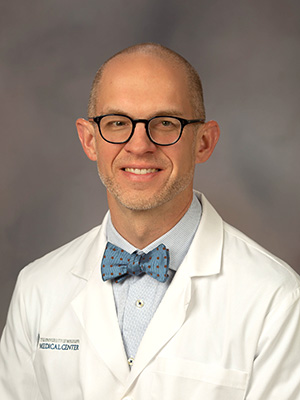
"I have been incredibly impressed with how senior and junior medical students have stepped up," said Henson, UMMC chief of medical staff and professor of medicine-pediatrics.
"They’re going above and beyond for patients. They’re doing things they don’t normally have to do, such as escorting patients.
"Because of this experience, they will actually be better at some of the skills they need to learn, including two of the most important: taking a patient’s history and doing a physical exam.
"There have been more opportunities for them because of this crisis. They haven’t missed a day; they haven’t asked to take off. The students are really on board."
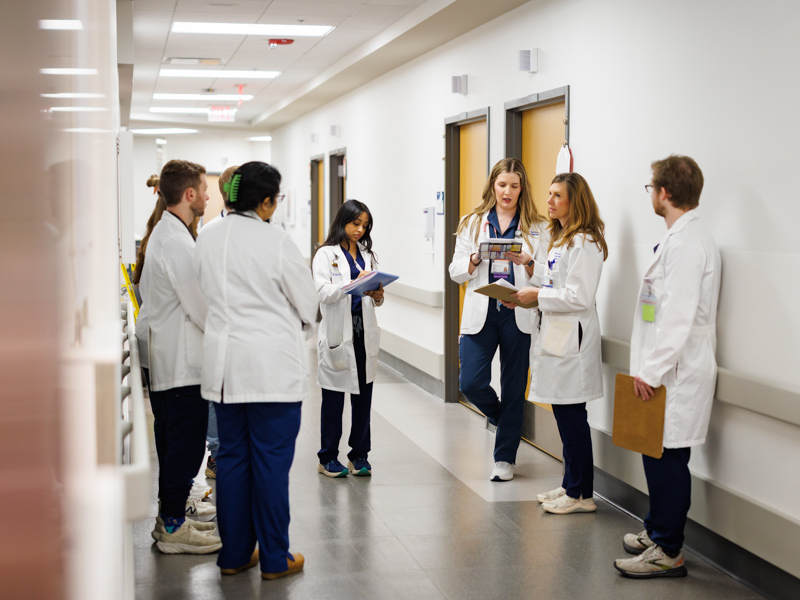
At UMMC, the last disruption of this scope was caused by the COVID pandemic — but there were differences, including for students.
"During COVID, students had to stay home in the beginning, which was detrimental to their psyche and their learning," Henson said.
"This time, they’re being embraced and given the opportunity to live up to their responsibility in a unique way."
With COVID, Norris said, "we lost connections to people. With this attack, we lost connections to our information and infrastructure.
"One of the biggest lessons we learned is how important it is to provide everyone with timely, clear information - without overwhelming them with communications, which can create more anxiety.
"Because of COVID, I became more aware of what I can turn to outside of the UMMC ecosystem.
"But COVID pushed us apart; this has pulled us together."
Contributors to this article are Annie Oeth, Danny Barrett Jr., Gary Pettus, Tally Connelly, Rachel Vanderford, L.A. Warren