


Front and Center: Chef Jonathan Boyd
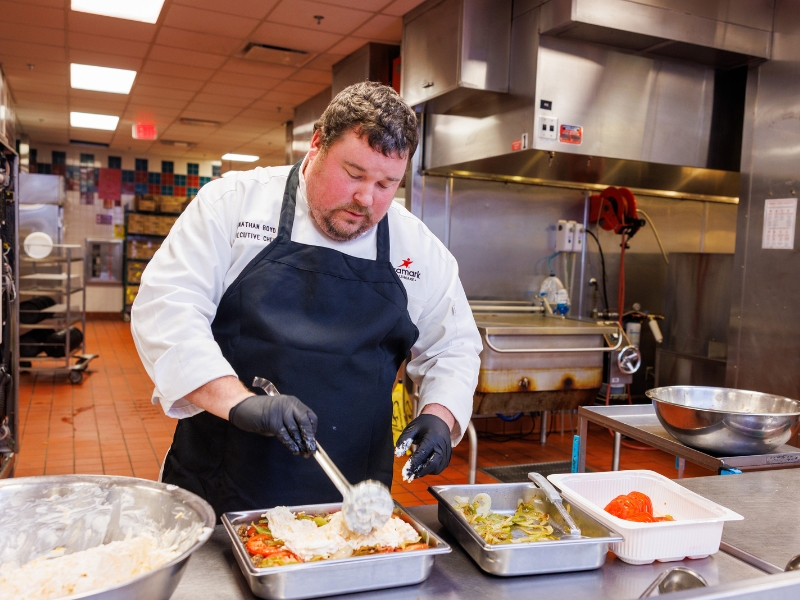
In that corner of the Medical Center world devoted to feeding the multitudes, there’s a total of 11 kitchens; executive chef Jonathan Boyd is in charge of them all.
He oversees about 100 culinary employees in just the three University of Mississippi Medical Center cafeterias alone and some 36,000 daily transactions – involving anything from buttery mounds of turkey and gravy to amber fountains of sweet, iced tea – for 7,000-8,000 hungry people, he says.
Throughout his career, Boyd has worked at Starbucks coffeehouses, grease-stained kitchens and Michelin-starred restaurants; his desserts and dinners have been tasted by everyone from exacting Southern grandmas to an ex-president of the United States.
But this son of a Southern Baptist preacher who took to heart the heaven-sent lessons of goodness and mercy recently found himself in a place called Hell – “Hell’s Kitchen,” that is – possibly the most intimidating experience of his culinary life.
“I wanted to do something to make my kids proud,” said Boyd, a father of six, explaining why he chose to do battle in the Fox network’s gladiatorial cooking spectacular. “My middle son, Paxton, who’s 12, is autistic, and his entire world is cooking shows.
“And part of the reason is that you just want to push yourself.”
He had come to the right place; leading most other celebrity chefs in the category of pushing assists is Gordon Ramsay, the High Priest of “Hell’s Kitchen,” who gave Boyd a devil of a time about his scallops and some cheese.
Even so – spoiler alert! – Boyd did what many of his fellow chefs could not: He made it as far as Episode Seven of HK’s Season 24, “Battle of the States,” staged in a casino’s kitchen in Mashantucket, Connecticut.
Considering the respect Boyd has for the other competitors who are still steeped in battle for the $250,000 grand prize, that’s some deed – a bit of glory reflected onto the Medical Center, even if he’s technically a contract worker for UMMC’s food service vendor, Aramark.
“I don’t think the show does justice to how bright the chefs are,” Boyd said. “Because it’s TV, you focus on the drama. But there are some crazy-talented chefs there, and that isn’t showcased enough.
“That would be the only criticism I would have; I was so grateful for the chance to be on the show.”
Brought up in Newnan, Georgia, Boyd represented the Peach State. For Episode One’s Signature Dish Challenge, he presented a golden Southern special to the skeptical tastebuds of Gordon Ramsay – and won him over. Score: four out of a possible five points for Boyd’s chicken and waffles.
At episode’s end, the survivors were named. The final name called was Boyd’s. “The last shall be first,” Boyd said in a post-competition interview, “and the first last.”
It was a promising start, especially for someone who chose a chef’s life, in part, so he could excel at something that did not interest his accomplished brother – “even though, at that point, I didn’t even know how to cut an onion,” Boyd said.
He did know his TV chefs: Emeril, Wolfgang Puck and others – stalwarts of what Boyd calls “the Age of the Good Food Network.” He also knew to how to listen to, and assist, his maternal grandmother as she baked her way to glory. Martha Tanner had a cake-baking business, he said, that sugared-up the palates of former president Jimmy Carter, a fellow Georgian, among others.
Boyd also grew up cooking collard greens, black-eyed peas, chili and other staples from a region where mac and cheese is a vegetable and crispy fried chicken is your superhero. Although he earned music and psychology scholarships to Jacksonville State University in Alabama, and could play just about any brass instrument you can name, he chose to make sweet music in the kitchen.
As a veteran of a Starbucks in the Chattahoochee Hill Country in Georgia, Boyd attended a job fair there, which led to a spot at the restaurant of the legendary Chef Hilary White, owner of The Hil restaurant and, Boyd said, “90 pounds of fury.
“I’m more afraid of her than I am of Gordon Ramsay.”
His tutelage at the Hil was his big break. There, he met celebrity chefs and athletes. “I’ll always be grateful for the opportunity I had there,” he said.
There, he learned that standard Southern dishes could be “something special. Fine dining,” he said.
The food he had once taken for granted impressed him more and more – and not just the high-end versions. “We have something very special here in the South,” he said, “including in Mississippi.
“The best seafood gumbo I’ve had was not in New Orleans, but at a gas station in Pass Christian.”
A culinary school graduate, Boyd has been a corporate chef or consultant for kitchens in hospitals and restaurants in several states and cities, including the Westin in Jackson. Eventually, Aramark recruited him; six years ago, he and his family moved to Crystal Springs, about a half-hour south of Jackson.
When Aramark took over dining services at UMMC, they named Boyd executive chef. His goal here: “To make sure the food we serve is regionally reflective, the kind that will make your grandmother proud.”
Aramark is happy to have him, said Danielle Pittman, the company’s human resources manager. “He’s always there to give us a laugh. He’s so humble and others should know of his accomplishments.
“From the time Chef Jonathan stepped into UMMC, he has brought a standard of excellence like no other.”
Southerners in general have high standards and expectations concerning their food – maybe even more so than for their football teams – a fact reinforced by the long-awaited Second Coming of a casserole named for an iconic movie star.
It owes its revival in the Medical Center’s hospital kitchen, at least in part, to lobbying by Boyd’s sous chef, Farrah Powell.
“I love the John Wayne Casserole,” Powell said.
One day earlier this month, Boyd was in the kitchen overseeing the prep work for the following day’s John Wayne debut – or re-debut. That very night, during the HK episode recorded months ago, Ramsay would tell Boyd to turn in his chef jacket – apparently because of some fries topped off with the wrong kind of cheese.
As a member of the Blue Team (vs. the Red) Boyd had some impressive moments behind him – including his masterful handling of some racks of lamb. Apparently, the inadvertent cheese selection and perhaps an earlier incident with some scallops – categorically condemned as “RAW!” – were the straws that broke Boyd’s streak, but not his spirit.
“I’m proud of what I’ve done,” he said. “I didn’t do anything that I’m embarrassed for my wife and kids to see.
“I enjoyed the camaraderie with the other competitors. Even now, I and other members of the Blue Team chat every day – we share recipes and ideas about menus.”
Among the menus Boyd has considered is the one he would choose for his very last meal on earth. It includes, if you can believe it, scallops. But hold the cheese and fries.