


Front and Center: Jason Dill

Jason Dill grew up to be, as he put it, “not unlike I am today – a little chubby guy,” eventually turning an accounting degree into a job as business administrator in the Department of Pathology.
But as an infant, Dill’s health took a mysterious turn for the worse that was reversed in time thanks to the same field of study for which he now works.
“My parents noticed just after I turned a year old that I was losing weight rapidly and didn’t have much of an appetite,” said Dill, now 45. “My skin was more and more jaundiced, and some blood tests were pointing things in the direction of leukemia. A 1-year-old can’t really tell you what’s going on, right? I kept getting sicker and was eventually admitted to Children’s of Mississippi.”
As has been told to him by family, one of the hematology and oncology physicians at the time, Dr. Rathi Iyer, made a face while looking at his charts and concluded something other than leukemia was the source of his rapid weight loss and worsening appearance.
“She worked with several pathologists on staff at Children’s, and they discovered I had no abnormal white blood cells as is seen with leukemia cases,” he said. “It was actually something called hemolytic anemia, which is where the body destroys the red blood cells faster than it can reproduce them.”
The condition comes in multiple forms for both adults and children, and the treatment depends on the cause. Studies have shown the causes in children to include infections, autoimmune diseases, cancers, certain medications and rare conditions such as Evans syndrome.
Doctors at the time concluded Dill likely developed the condition after a rare allergic reaction to certain antibiotics.
In the early 1980s when Dill was a patient, the main course of treatment involved prednisone and, in some cases, removal of the spleen.
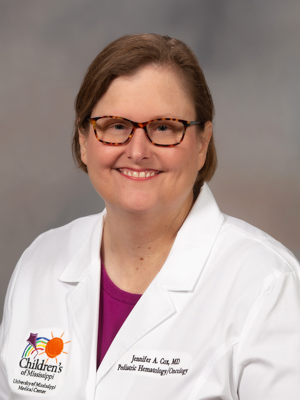
“In 1987, intravenous immunoglobin (IVIG) came along, and we found that if you used both together, there was a much better outcome and a splenectomy often wasn't needed,” said Jennifer Cox, professor of pediatric hematology and oncology at Children’s. “We try to avoid it due to the severe risks of infection after removing it.”
Today, additional medication is often added to courses of treatment that can kill certain cells that lead to the production of antibodies to red blood cells.
“This has been a game-changer in refractory disease and prevents many splenectomies,” Cox said.
For Dill, the road to recovery was the simpler one, with a brief course of prednisone.
“I was discharged in about a week,” he said. “Pathologists’ work to figure it all out saved a lot of unnecessary pain and cost to my parents. I’m here, I’m healthy, and the condition hasn’t presented itself at all in my 9-year-old son.”
Dill’s career arc at UMMC began in 2017 and has passed through many of the same places where he spent time as an infant patient at Children’s. Prior to his current job, he was an accountant and, later, director of business operations for the School of Nursing, then worked as director of budget and finance for pediatrics.
“My mom always has said how nice the nurses were when I was a patient. I actually worked with one of them, Ladonna Northington, when I worked at the nursing school. She retired not too long ago, but was a brand-new nurse at the time. And I worked just across from the hem-onc group when I worked in pediatrics. And now I’m in pathology, so it’s one of those full-circle things we see at UMMC among people who were once patients here,” Dill said.