


Front and Center: Mirna Vargas
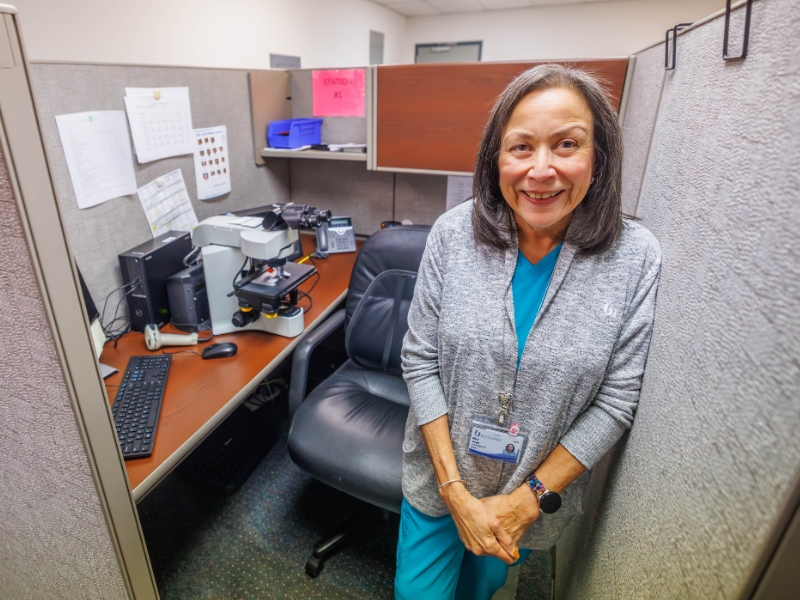
Most patients never meet the people who play a vital role in their diagnosis. But for Mirna Vargas, that responsibility has always been personal.
Trained as a cytotechnologist, Vargas has spent the past 30 years working in pathology laboratories, where attention to detail, consistency and accuracy are the keys to determining a patient’s next steps in care. Now a member of the University of Mississippi Medical Center’s lab quality team, Vargas continues to advocate for the behind-the-scenes work that supports nearly every diagnosis made across the health system.
Cytology is a specialized area of pathology that focuses on examining cells to identify disease, particularly cancer. Cytotechnologists carefully screen samples—such as Pap tests and other minimally invasive specimens—to identify abnormalities that can lead to early diagnosis and timely treatment.
“We make sure not to miss a single specimen,” Vargas said. “Because one specimen is one patient."
Originally from Nashville, Tennessee, Vargas’ career journey has been shaped by service. At 20, she joined the U.S. Air Force, inspired by her older brother, who later became a commercial pilot. She spent 16 years in the military, stationed everywhere from Texas to Turkey to North Dakota, while raising a family and developing the discipline and accountability that would later define her approach to laboratory medicine.
“I always knew I wanted to go into the medical field,” Vargas said. “When I retired from the Air Force at 36, I knew medical school wasn’t realistic. I started out in nursing. But then I learned about cytology.”
Introduced to the field while attending the University of North Dakota, Vargas was drawn to cytology’s focus on early detection and precision. The work requires careful screening, strong judgment and an understanding that each slide represented a real person waiting for answers.
“But the more I learned about it,” she said, “the more I loved it.”
After working in a small laboratory in South Carolina, Vargas joined UMMC a decade ago as laboratory manager for anatomical pathology. Her oversight spanned surgical pathology, histology, immunohistochemistry, electron microscopy, cytology and the morgue, giving her a broad view of how pathology functions as the backbone of patient care.
“When pathology isn’t working the way it should,” Vargas said, “it affects everything downstream.”
Her early months at UMMC were challenging. Adjusting to heavy specimen volumes and other challenges strained both technologists and pathologists.
Rather than distancing herself from problems, Vargas stepped into it. She worked alongside technologists, filing slides, screening cases and helping rebuild workflows from the ground up.
“If you’re disorganized, you’ll never get on track,” she said. “You have to stop, organize and start again.”
Over time, training improved, workflows stabilized and timeliness improved, protecting turnaround times and ensuring that diagnostics reached clinicians when it mattered most.
“I’d rather have five people who are independent and trained well than fifteen running in different directions,” Vargas said. “If you’re doing your job the right way, nobody can argue with that.”
During her eight years as manager, Vargas’ leadership left a lasting impression.
“Mirna demonstrated exceptional leadership, dedication and professionalism that truly shaped our department,” said Miranda Magee, pathology technologist and colleague of Vargas. “She led by example and fostered a culture of respect, teamwork and excellence. Even after her retirement, we were — and still are — thrilled to see her return. Her commitment speaks volumes about her passion for this work.”
Vargas returned to the lab in 2023. She was asked to join UMMC’s laboratory quality team— a role that allows her to apply decades of cytology and pathology experience across the entire laboratory system.
As part of the quality team, Vargas helps ensure laboratory practices remain accurate, compliant and consistent, particularly during inspections by the College of American Pathologists, which occur every two years. The team reviews workflows and works closely with laboratory leaders to identify and resolve issues before they affect patient care.
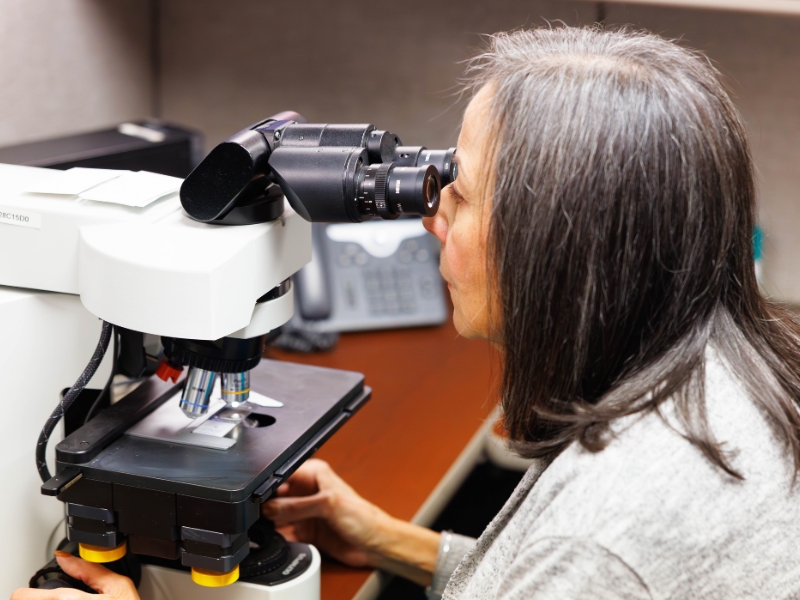
The work extends beyond UMMC. Vargas and her colleagues are frequently asked to assist with laboratory inspections at institutions across the country, lending their expertise to ensure quality and safety nationwide.
She shares the office and the workload with Lawrie Waldrip, a medical laboratory scientist who focuses on clinical pathology while Vargas focuses on anatomical pathology. Together, along with their manager, the three-person quality team provides continuity across both sides of pathology.
“We work really well together,” Waldrip said. “We divide responsibilities between clinical and anatomic pathology, but we stay up-to-date with both sides of the lab.”
“Mirna is the ultimate professional,” said Vonda Clack, laboratory quality and compliance manager. “She has a great work ethic and takes ownership. She is a positive role model and I am excited to have her on the lab quality team.”
Beyond her daily responsibilities, Vargas volunteers each year with the College of American Pathologists’ See, Test & Treat program, which provides free cancer screenings and same-day results for uninsured and underinsured patients. The program focuses on early detection of cervical, breast, oral and lung cancers.
For Vargas, the event is a powerful reminder of the human impact behind laboratory work.
“That’s where you see how much early detection matters,” she said. “Those patients are waiting for answers, and the lab plays a huge role in making sure they get them.”
Vargas has seen firsthand how timely screening and accurate pathology results can change and save lives, emphasizing the importance of the work she does every day.
“It’s not about us,” she said. “Whether there’s an ice storm or a global pandemic, those patients rely on us. And we have to show up for them no matter what."
After three decades in the laboratory, Vargas said she is just as passionate about her work as the day she began.
“If you love what you do, you’re not really working,” she said. “And that’s absolutely true for me.”