


Even in death, they teach: 2026 Ceremony of Thanksgiving honors UMMC anatomical donors
Years before Robert Walters of Vicksburg, Mississippi, died, he and his wife, Ann, made a decision together — to donate their bodies to science.
Robert fulfilled that promise in January 2025. Ann plans to do the same one day. For now, she stands alongside her family, reflecting on the extraordinary gift he made — one that will help health professional students learn, grow and ultimately care for others.
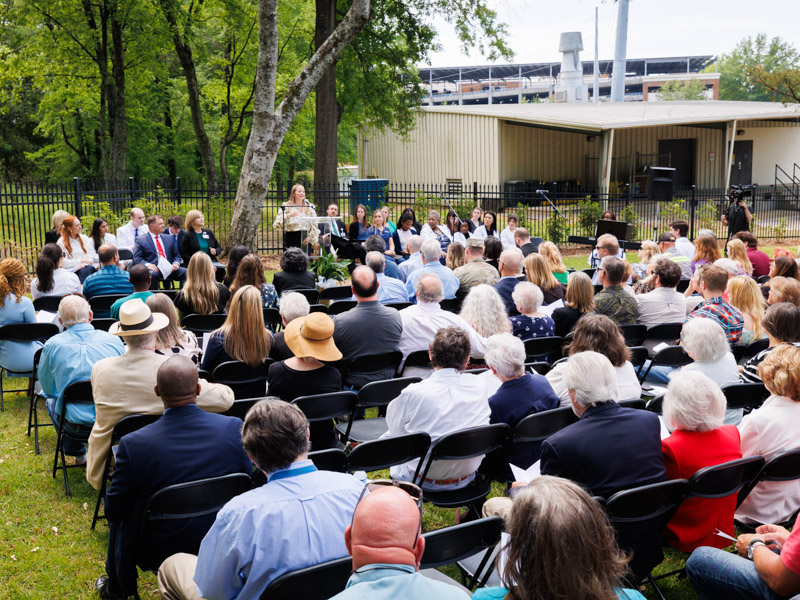
They were among dozens gathered April 22 at the University of Mississippi Medical Center cemetery for the annual Ceremony of Thanksgiving, held in memory of anatomical donors. The event honors those whose final act was one of quiet generosity.
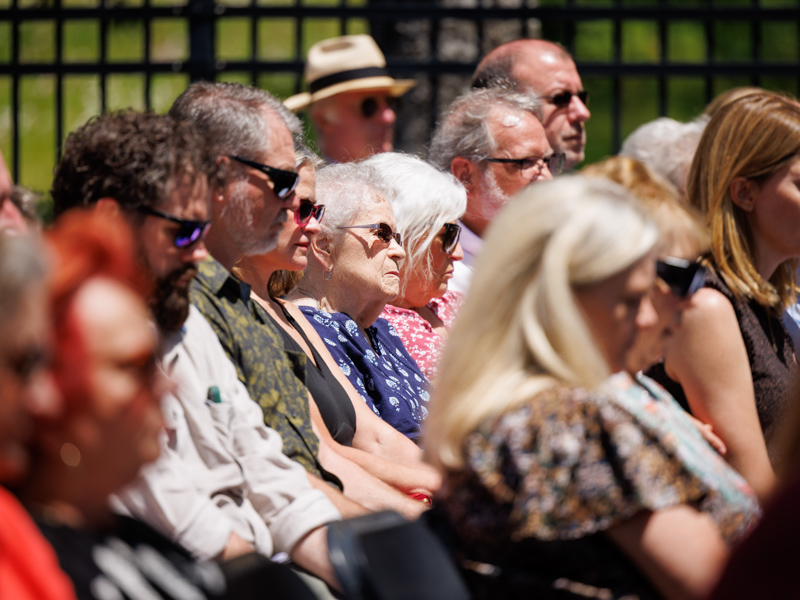
For families, it was more than a ceremony. It was a chance to remember, to give thanks and to see firsthand how their loved ones’ decisions continue to make a difference.
The program included musical selections by the campus Cantus Medici Choir, adding a tone of reverence and reflection and underscoring the gratitude shared by students, faculty and families.
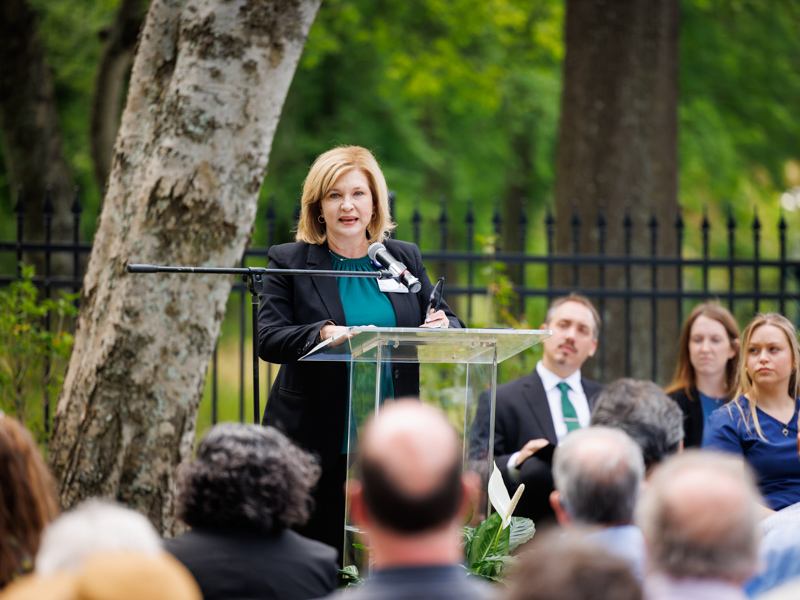
Dr. LouAnn Woodward, vice chancellor for health affairs and dean of the School of Medicine, spoke directly to families who made deeply meaningful decisions during life’s most difficult moments.
“The ceremony today gives us the opportunity to show our appreciation to our anatomical donors,” she said. “It also gives us the opportunity to share with you how grateful we are for that gift — and for your support of it. We know these decisions are made during a time of great distress, and that is very difficult.”
Woodward reflected on her own experience as a first-year medical student in 1987, learning from an anatomical donor.
“I want you to take away not only our deep appreciation, but also the understanding that whatever role your loved one held in life, you can add to that list of accomplishments that they were a teacher,” she said. “Without saying a word, they taught.”
For Ann Walters, her husband’s decision was never sudden. It was rooted in belief.
Robert Walters experienced firsthand the compassion and expertise of medical professionals during his illness. In response, he chose to give back in a way that would outlast him.
His son, Mark Walters, said his father was intentional — even down to the smallest details. On the bottom of his donor form, Robert left a handwritten note that reflected both his humor and his perspective:
“Don’t laugh — you’ll be old one day.”
Mark said his father hoped the students who learned from him might smile at the message. Even now, it brings comfort to the family — a reminder that humor and generosity can coexist, even in life’s most serious moments.
His daughter, Tracey Short, recalled years of conversations that made clear his decision was not a passing thought, but a lasting conviction.
For UMMC students, those lessons begin immediately.
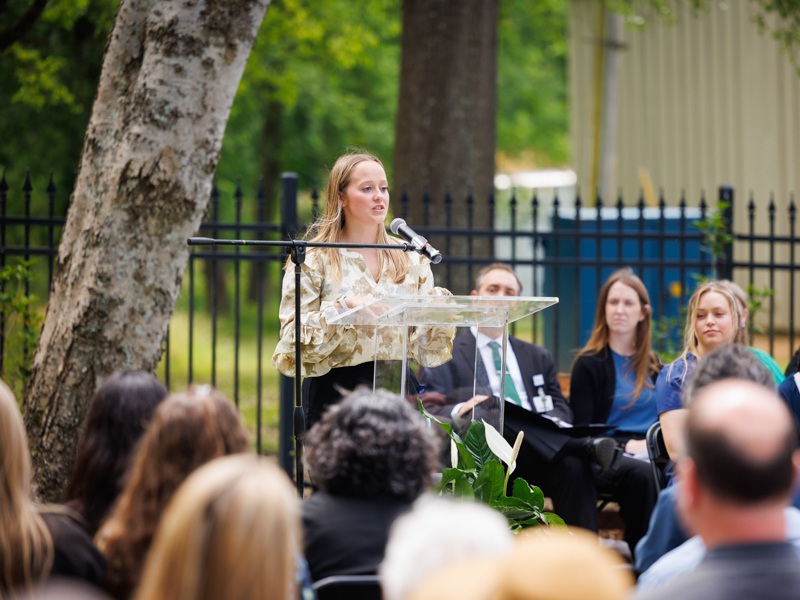
Morgan Brown, president of the occupational therapy Class of 2028 in the School of Health Related Professions, spoke with gratitude.
“Our very first class was human anatomy, where we were introduced to our first patients,” she said. “They have prepared us to care for future patients with integrity and respect. What they provided cannot be found in a lecture or a textbook.”
Kiersten Selman, president of the first-year physical therapy class, reflected on the curiosity and connection students feel.
“I wondered how they interacted with others — if they loved to teach or were simply naturally good at it,” she said. “Other days, I wondered how they were known by the people here today. Were they a spouse, a parent, a sibling, a grandparent, an aunt, an uncle, a friend?”
She paused before adding, “Your loved ones were our first teachers.”
Joshua Berry, a first-year student and president of the School of Dentistry Class of 2029, described the lasting impression.
“When I first walked into the gross anatomy lab, I remember thinking, ‘Who was this person?’” he said. “Did they live life to the fullest? Were they shy or outgoing? Did they achieve what they hoped to in life?”
Though those questions remain unanswered, Berry said one truth was clear: “This was someone of incredible selflessness and character.”
“Many people hope to make an impact in the world,” he said. “It takes someone truly extraordinary to continue impacting the world even after their life.”
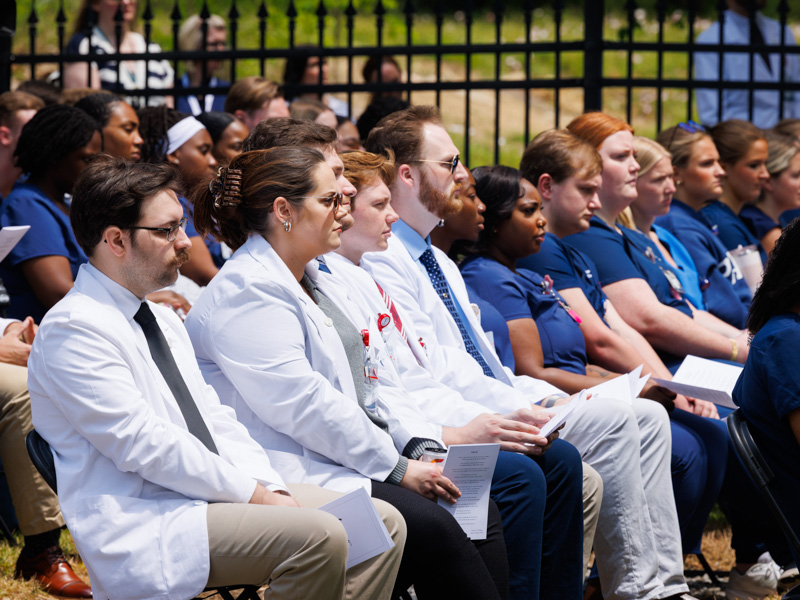
Anderson Rings, president of the School of Medicine Class of 2029, spoke about the responsibility that comes with such a gift.
“They taught us to treat the human body with dignity, to handle each moment with care and to never forget that every lesson in medicine is tied to a human life,” he said. “They showed us what trust looks like and what a privilege it is to learn in service of others.”
He added that the experience reinforces a fundamental principle in medicine.
“So much begins with listening — learning someone’s story and understanding what may lie beneath the symptoms they carry,” he said.
For Jhansi Lakshmi Chavan, a first-year clinical anatomy student in the School of Graduate Studies in the Health Sciences, the experience reshaped her understanding of medicine.
“The silence, the stillness and the awareness that before us lies not just a source of learning, but a life once lived,” she said.
She recalled her first day in the lab.
“There was hesitation in my hands, a storm of emotions in my mind — curiosity, but above all, respect,” she said. “I realized that someone made a conscious decision to help students like me.”
That lesson, she said, extends beyond anatomy.
“We promise to honor their gift by striving to become skilled, ethical and compassionate health care professionals.”
Hawthorne Cleveland, a class representative for the Master of Biomedical Sciences program, spoke about the broader impact of anatomical donation.
Drawing on lessons from her parents — both physicians — she described what she called the “multiplier effect.”
“An organ donor can save up to eight lives. A tissue donor can improve the lives of as many as 75 people,” she said.
She then explained the impact of anatomical donors.
“This year alone, anatomical donors at UMMC helped teach nearly 400 students,” she said.
“Each of those students will go on to treat thousands of patients over the course of their careers.”
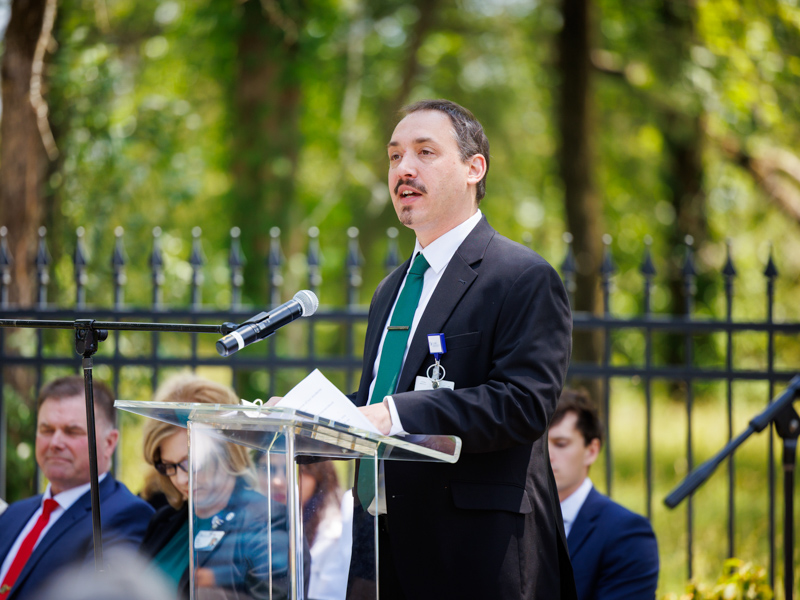
“These are the results of someone who decided their body could be a classroom,” she said.
“There is an old understanding — that those who teach never truly die.”
To ensure their memory endures, Dr. Nathan Tullos, associate professor of advanced biomedical education, introduced the students who read the names of donors — a tradition he described as the “roll call of heroes.”
Each name served as a reminder: these were not just donors, but mothers and fathers, teachers and workers, neighbors and friends — and now, educators.
As the ceremony concluded, Tullos reflected on their lasting gift.
“These individuals gave more than their bodies,” he said. “They gave knowledge, compassion and perspective.”
Tullos said the Anatomical Gift Program was established in the early 1970s after Mississippi’s adoption of the Uniform Anatomical Gift Act. The program accepts only donors who are Mississippi residents. The program currently has around 15,000 living, registered donors.
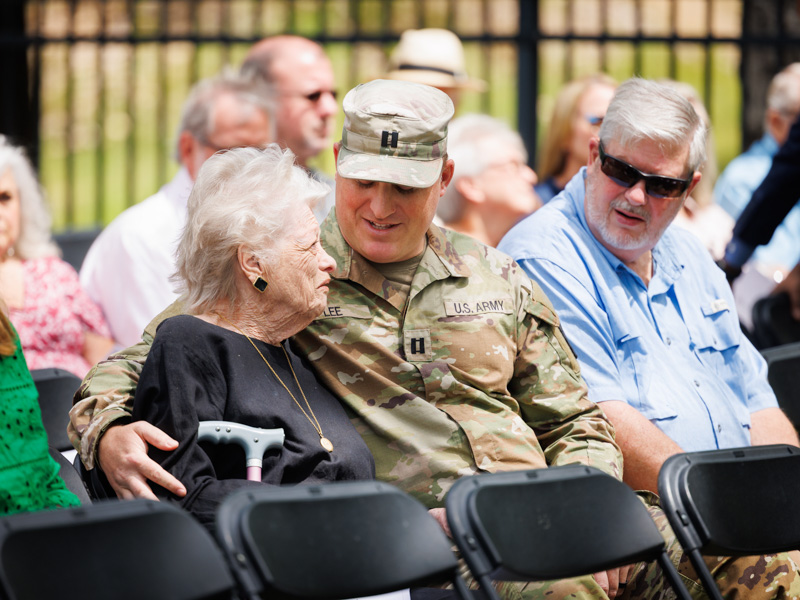
Meanwhile, for many families, the ceremony reaffirmed the meaning behind their loved ones’ decisions.
Joyce Easley of Madison, Mississippi, attended in memory of her husband, Harry Easley Sr., who made the same choice 14 years ago.
His decision, she said, was rooted in gratitude after a long illness.
“He wanted to help other people,” she said.