


Rare, fully preserved cast iron casket recovered from Asylum Hill excavation
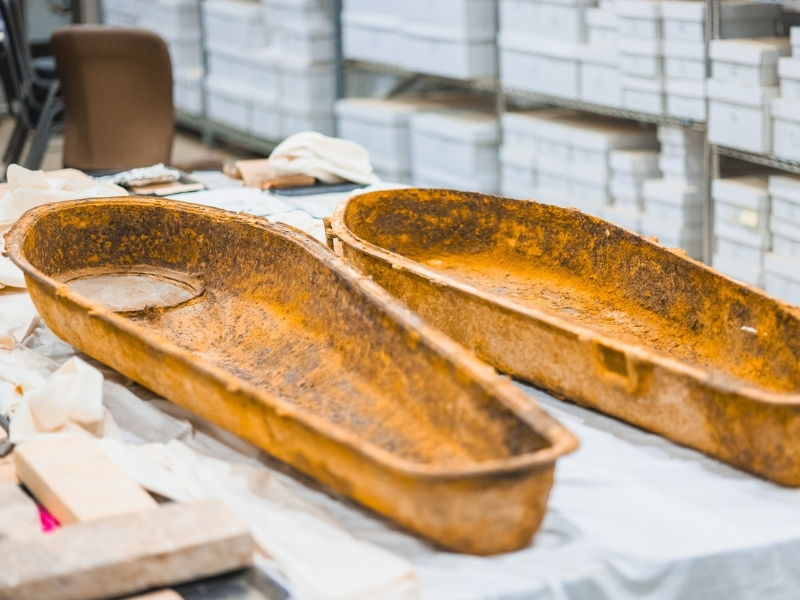
Archaeologists excavating remains from the site of the Asylum Hill Cemetery on the University of Mississippi Medical Center campus have unearthed a rare, fully preserved cast iron casket dating back to the late 1800s.
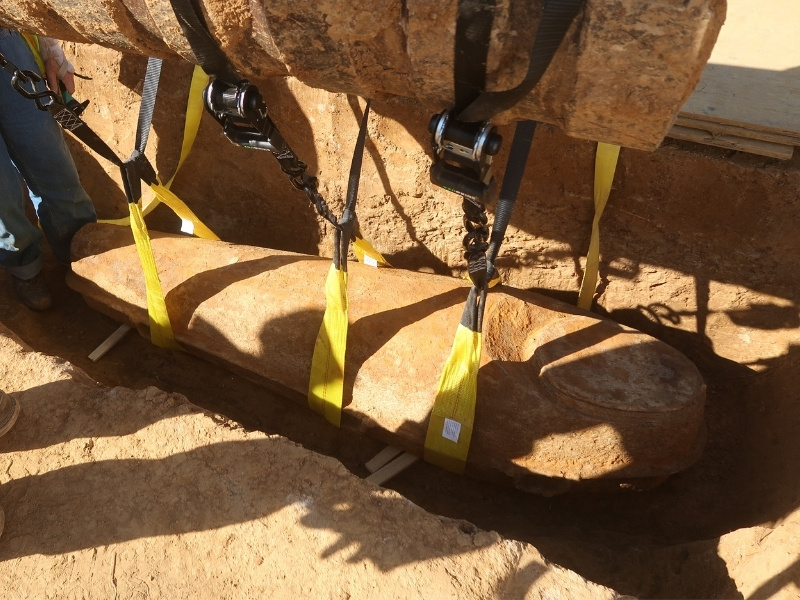
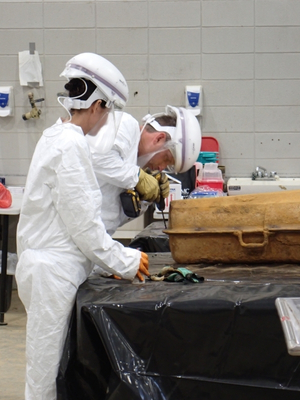
The rusted casket, which weighed nearly 200 pounds and was sealed with 24 heavily corroded bolts, was discovered in March by a six-member excavation team near the ridge of the cemetery. Researchers say the find is unlike anything uncovered since the excavation project began.
Dr. Jennifer Mack, lead bioarcheologist, said cast iron caskets were uncommon in institutional cemeteries because of their cost.
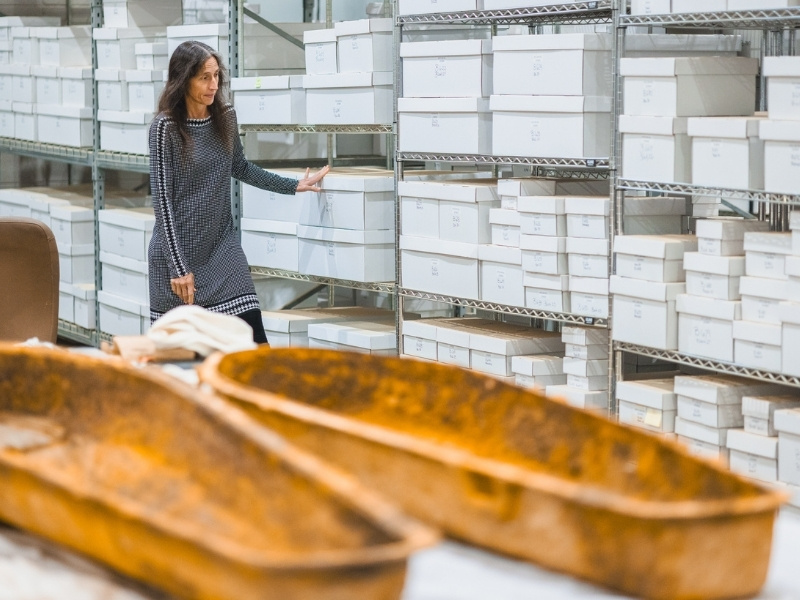
“We have seen in the patient records where someone has said, well I can’t get my loved one, but we are going to wire this much money for the purchase of a casket,” said Mack. “It wasn’t uncommon for people to send the money for a burial here, but the cast iron casket is just a particularly pricey example of that.”
According to Mack, it is possible the individual’s family purchased the casket with plans to reclaim their loved one, but those plans may have changed.
Historical records indicate that a cast iron casket in 1865 cost approximately $44.11 wholesale, including shipping and a protective shipping box. In contrast, a plain wooden coffin during the same period cost about $2.50.
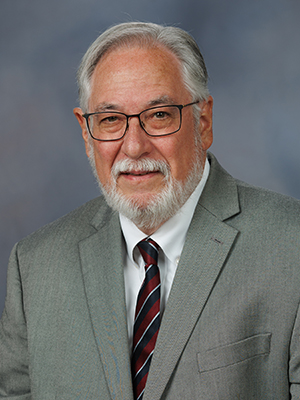
Dr. Ralph Didlake, director of the Asylum Hill project and a skilled carpenter, created a reconstruction of what a simple wooden coffin from that era would have looked like for those buried in the cemetery. He noted that burial practices and transportation methods were markedly different at the time and emphasized that the stories of those interred at the site are of significant historical interest.
“It’s less about the individual coffin than it is about the individual story of the Asylum cemetery and the fact that it is very deep,” said Didlake. “Everyone is an individual and every story has meaning because it reflects the time and it reflects us. These people all have a name and an experience and relationships and the stories, and how we preserve them reflects on us.”
Mack said it took the team more than two hours to open the casket using a drill. Once opened, researchers discovered cracks in the lid and sides and a damaged glass viewing pane beneath its metal cover. The damage likely accelerated the deterioration of the remains inside.
Researchers believe the individual was a woman of European ancestry between the ages of 30 and 55 at the time of her death. Mack estimated the woman stood between 4 feet, 9 inches and just over 5 feet tall.
The only personal item recovered from the casket was a brass ring with a red glass center “gem.” Researchers also found the woman had lost all of her teeth before her death, making identification more difficult.
Mack said the excavation crew worked closely with UMMC’s Department of Environmental Health and Safety, the biological safety officer, the chemical safety officer and Employee Occupational Health Services to ensure the safety of both the team and the public throughout the recovery process.
The Department of Advanced Biomedical Education provided expertise, protective equipment and secure storage for the remains until testing confirmed there was no biohazard risk. The Center for Comparative Research remained on standby to provide additional analysis space if needed, while the Department of Biomedical Materials Science is currently analyzing samples to determine whether embalming chemicals are present.
According to biological safety officer Anthony Walters, the opening of the cast iron casket was a carefully coordinated effort. While there was initial hesitancy due to concerns about its contents, multiple safety procedures were in place prior to opening. Walters noted that despite those concerns, there was also a sense of anticipation, and the team worked quickly to ensure preservation efforts were maintained.
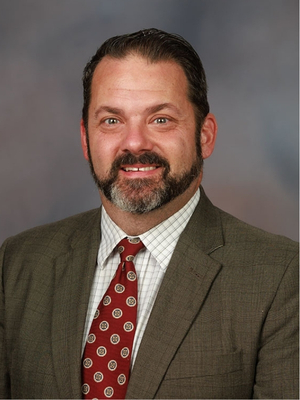
“From a biological safety standpoint, we were able to learn a lot because it was a unique situation, so we were able to see this is what we are capable of and maybe these are some areas we can adjust a little bit,” said Walters. “I think this gives us a much broader view of the historical health of Mississippi and a better understanding of what the Asylum did and who was here because there are a lot of misconceptions.”
Didlake, Walters and Mack are hoping this new discovery will help change the narrative of Mississippi and also shape the state’s future.
“We have, in a very tangible way, inherited these patients, and we will take care of them in a very ethical, respectable way,” said Didlake. “It cuts across our education mission; we have created opportunities for students to come and others to come and learn about how this type of work is done. We will certainly leverage every opportunity to do appropriate research through the excavation and learn about the remains, but even overarching is that the project will provide and allow us to repurpose land for the campus for our future patients.”
While excavation crews have uncovered remains from wooden caskets throughout the project, this marks the first cast iron casket recovered from the site.
The team is awaiting results of X-ray imaging on the remains in hopes of learning more about the woman’s possible cause of death.
Researchers estimate between 5,000 and 7,000 individuals are buried within the cemetery’s 12-and-a-half-acre site. Mack said the estimate is based on a 1948 engineering plan and calculations of burial density across the property. At least 1,065 bodies have been exhumed.
To support the ongoing excavation efforts, the Mississippi Legislature appropriated more than $3.68 million to the Asylum Hill Project.