


Student spotlight: leadership, learning and impact at SOPH
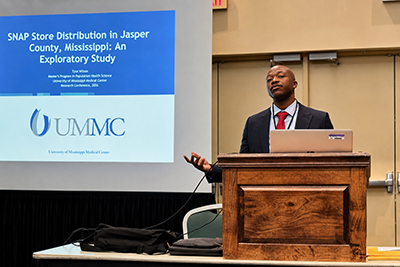
Tyus Wilson graduated this spring with a Master of Science in Population Health Science from the John D. Bower School of Population Health. A rural Mississippian with a background in nutrition and health promotion, Wilson focused his research on access to SNAP-authorized stores and the ways geography, food infrastructure and community conditions shape health opportunity.
How did growing up in rural Mississippi shape the way you think about health, access and community needs?
Growing up in rural Mississippi greatly shaped how I view health, access and community needs. For a long time, I viewed health and its intersections as black and white. I thought either you were sick or you were not, either you chose to go to the doctor or you did not, either you chose to eat healthy or you did not.
After my academic and professional experiences, I have a greater and more realistic view. I realize that living in a rural town, especially in rural Mississippi, there are other factors that contribute to how we perceive and receive health care. The reality is that we often have to drive longer distances to get specialized health care. We rely heavily on community partners, including churches and schools, during crises. Limited economic opportunities, lower incomes in some areas and lack of insurance can make access more difficult.
Your capstone focused on SNAP-store distribution. What led you to choose that topic?
My undergraduate education was in nutrition and health promotion, so I naturally gravitate toward topics dealing with food, food infrastructure and the impact of food access on chronic disease. SNAP-store distribution was no different.
I think it is common to assume that just because someone receives help from the federal government, such as food stamps, they have all the tools they need to make the “healthy” choice. That is simply not the case. There are other variables to consider when we discuss food access and making the healthy choice.
For example, I live in a rural town and the only nearby access to food comes from either Dollar General or a convenience store. Maintaining a lifestyle that includes fresh fruits and vegetables and other healthier choices would be incredibly difficult in this scenario. Unfortunately, this is the reality for many rural Mississippians.
Why does access to SNAP-authorized stores matter for population health?
Access to SNAP-authorized stores is a multifaceted issue. It matters for population health because it affects whether people can realistically use their nutrition benefits to obtain healthy food.
The caveat is that having SNAP benefits alone does not guarantee access to nutritious options if the nearest authorized retailer is far away, difficult to reach or has limited fresh food options. Over time, poor access to nutritious food is associated with higher risk of chronic diseases such as obesity, type 2 diabetes, hypertension and cancer.
This issue is especially important in rural communities and underserved neighborhoods where residents may have limited transportation, fewer grocery stores and limited education on how to choose the healthier option.
What did your research reveal about food access in Mississippi communities?
My research helped reveal that the distribution of SNAP-authorized stores is more than a question of retail geography. It is an indicator of the food environment and a factor that influences dietary behaviors, health equity and community well-being.
In my study, the northeastern region of Jasper County had no active retailers, which means any SNAP participants in that region would most likely have to travel outside their town to use their benefits. These types of barriers can contribute to food insecurity and make it more difficult to maintain diets that support good health.
How did the MS in Population Health Science program prepare you to study this kind of public health issue?
My time in the program has been eye-opening and deeply transformative. The program integrates the interdisciplinary knowledge and analytical skills needed to investigate complex public health challenges like the one I studied.
Rather than focusing solely on individual health outcomes, the program gave me the ability to examine how social, economic, environmental and policy factors interact to influence health outcomes across populations. Through coursework in epidemiology, statistics and social determinants of health, I developed the ability to analyze large datasets, identify patterns in health disparities and evaluate the impact of public policies and interventions.
Beyond analytical skills, the intensity of the research courses helped me learn how to translate research into practice. I also learned how to communicate findings to important personnel, health care leaders and community organizations.
How do you hope to use your training moving forward?
As I look ahead, I hope to use my training in population health science to improve health outcomes in Mississippi and other rural communities by focusing on prevention rather than treatment alone.
I am particularly interested in how nutrition, food access, physical activity and health education influence long-term health, and how evidence-based interventions in these areas can reduce the burden of chronic disease. My research interests are centered on understanding how people’s environments shape their health behaviors.
Questions about access to nutritious food, opportunities for exercise and preventive health education are especially meaningful to me because these factors can have a lasting impact on individual and community health. I am also interested in nutrition epidemiology and how population-level research can identify relationships between diet, lifestyle and disease, ultimately informing policies and programs that improve health outcomes.