


Student spotlight – Angie Garrett
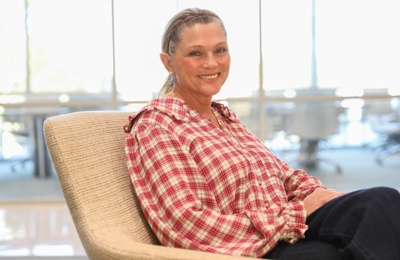
Where are you from and what brought you to the Bower School of Population Health?
I'm from Tupelo, born and raised in North Mississippi. Before I applied to the PHS program, I read about Dr. John D. Bower, and learned how he went about his business, including how he allowed civil rights workers to use his office space when in Mississippi; that drew me in. He was a real boots-on-the-ground kind of guy. He did many things to improve the lives of people in Mississippi, and he did these things in ways that had never been done before. He was bold, innovative and fierce in his commitment. That is what I came here to be. That is the legacy I hope to carry forward.
Please describe the path from Certified Alcohol & Drug Counselor and trauma-informed interventionist to population health scientist?
Throughout my career, I have traveled the country working with individuals experiencing addiction, trauma and mental illness. I saw how systems could either fail or uplift people seeking help. I also saw firsthand how community engagement, policy and research intersect to improve health outcomes for some of our most vulnerable populations. Then came the Covid-19 pandemic when everything I thought I knew about community care was tested.
Political polarization, misinformation, racial violence and rising overdose deaths converged in ways that felt overwhelming and deeply destabilizing. Day after day the preposterous outdid itself from the day before. As the pandemic persisted, racial tensions grew and overdose deaths skyrocketed. The emotional burden was heavy at times. Having spent my life as a community servant in one form or another, I felt powerless as I watched misinformation and stigma contribute directly to preventable suffering. I had never considered research as a career path, but it became clear to me that solid evidence-based solutions were necessary if we were to recover.
My involvement with community-led initiatives and addiction recovery services restored my hope in the power of collaborative, community-driven solutions and motivated me to move beyond one-on-one interactions so that I could make a difference at scale.
I restructured my entire life to realize this end. I sold my home in Mississippi and moved to Maryland to work as a research assistant in the Behavior Biology branch at Walter Reed Army Institute of Research and I have never looked back. I have found my calling. Research offers me an arena where I can apply relentless curiosity to real-world problems that I care deeply about. I find meaningful solutions to address problems that impact whole communities; this is what people desperately need at the individual level.
Why population health?
Population health offers the framework to bridge lived experience with scientific rigor. During the pandemic, I saw how social isolation, substance use and structural inequities interacted at the community level. Addiction thrives in isolation, while recovery depends on systems shaped by policy, economics and social cohesion. The system is not something separate from us; we are the system. A doctoral degree in population health will ensure that I have expert knowledge in a diverse field with a skillset that puts me in the middle of interdisciplinary research finding solutions. With these tools, I am able to investigate the underlying causes that drive both health behaviors and health inequities, develop prevention strategies, design interventions and then evaluate their impact to inform policy. This work takes me beyond treating addiction to dismantling the structural barriers that perpetuate it, particularly in rural, underserved communities where my own family and neighbors continue to suffer.
What are your goals after you graduate? How do you plan on using your degree?
My goal is to return what I learn to the communities that shaped me. Ideally, I will pursue a faculty position with an institution that shares my vision where I recruit and train the next generation of researchers with lived experiences. I plan to focus on community-engaged research that informs policy and reduces stigma-driven inequities in rural communities affected by addiction. I want to build a research-to-practice pipeline that centers communities as partners rather than subjects. I believe that we can create a paradigm shift if we begin to do research with communities instead of doing research on communities. Lived experience is gold, and it is just sitting there waiting for us to make use of it.
Using community-engaged approaches like the Johns Hopkins DIME Model, I plan to partner with universities, nonprofits, faith organizations, public health agencies and the criminal justice systems to develop and evaluate substance use interventions that work for people in rural Mississippi, with the potential to be replicated in rural communities nationally. I want to create diversion programs that move people away from incarceration and toward evidence-based treatment, challenge the criminalization of this medical diagnosis through policy research and develop science communication strategies that meet communities where they are: in churches, doctors' offices and community centers. I want to leverage the trust already established by local clinicians and clergy to combat widespread health disinformation and improve health literacy.
What would you say to someone who was thinking about enrolling at the School of Population Health?
I say come join us. We need you. The work is rigorous but sitting in a room full of likeminded people who left other careers because they genuinely care about making a difference will sustain you through the hard parts. We're not just learning methods; we're building a community of scholars committed to translating research into real-world change. If you want to help close the gap between what is and what could be, and you're willing to do the uncomfortable work of addressing structural inequities, you'll find your people here.