


Dr. Manju George is patient advocate lead in UK project
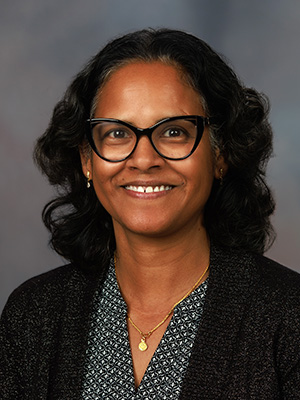
Dr. Manju George, assistant professor in the John D. Bower School of Public Health, a member of the UMMC Cancer Center and Research Institute outreach team, scientific director at COLONTOWN/Paltown Development Foundation and chair of the Mississippi Colorectal Cancer Roundtable, is patient advocate lead in the REWIRE CAN initiative. The international research team was announced at this year’s Cancer Grand Challenges Summit in London.
This ambitious project aims to transform how scientists understand and treat colorectal cancer, one of the most complex and stubborn cancers to target with precision therapies.
Despite major advances in cancer treatment, CRC remains uniquely challenging. Even when tumors share the same mutations seen in cancers like lung cancer or melanoma, CRC often responds very differently to targeted therapies. This is largely due to the disease’s intricate, overlapping signaling pathways, which can blunt or block the effects of drugs that work well elsewhere.
The REWIRE CAN team, led by principal investigator Dr. Bart Vanhaesebroeck, professor at The University College London Cancer Institute, is taking a bold new approach: studying and “rewiring” cancer cell signaling to better understand—and ultimately overcome — the biological barriers that make CRC so resistant to treatment.
As patient advocate lead, George plays a critical role in shaping the direction and impact of the project.
“My role is to ensure this project stays focused on what matters most to colorectal cancer patients and caregivers,” she said. “Despite advances in cancer treatment, CRC continues to be particularly challenging due to complex, overlapping signaling pathway. We have seen that drugs that work well in other cancers with the same mutations, such as lung cancer or melanoma, often fail in CRC. This highlights the need for approaches specifically tailored to CRC biology.”
George works alongside two additional patient advocates — a stage IV CRC survivor from the Netherlands and a stage IV patient from the United States — ensuring that patient voices remain central throughout the project’s lifespan.
“A key part of my role is also to educate patients, caregivers, and the public about the critical value of preclinical research,” she said. “From early discovery to testing in cell and animal models, this foundational work is essential to developing treatments that can move into clinical trials, and I aim to help make that process more visible and better understood by the public.”
REWIRE CAN is supported by a £20 million international collaborative grant funded by Cancer Research UK, the National Cancer Institute, and the Bowelbabe Fund. The team includes researchers from the UK, the United States, and the Netherlands, bringing together world‑class expertise in cancer biology, signaling pathways, and therapeutic development.
The scale of the competition underscores the significance of this achievement: 225 teams applied, 12 were shortlisted for interviews, and only five — including REWIRE CAN — were selected for funding.
The REWIRE CAN team will hold its official kickoff meeting in late October at the Francis Crick Institute in London, marking the start of a multi‑year effort to push the boundaries of CRC research.
For patients, caregivers, and advocates, this project represents hope—rooted not in speculation, but in rigorous science, global collaboration, and a commitment to keeping patient needs at the heart of discovery.