


Publications and Works
SIMM Initiative: Problem Impact Report
The SIMM Initiative Problem Impact Report efforts focused on developing and disseminating information on Mississippi's pregnant and postpartum women at risk for co-occurring SUD and IPV. This report seeks to identify, contextualize, and address co-occurring SUD and IPV among pregnant and postpartum women in Mississippi to improve efforts for SUD & IPV screening.
Select a topic to jump to a section.
Section I – Describing the Problem
Intimate Partner Violence (IPV)
Substance Use Disorder (SUD) and Intimate Partner Violence (IPV) During Pregnancy
SUD and IPV Screening and Education During Pregnancy
Section II - Addressing the Problem
Section III – Improving the Problem: Project Work
Data Inventory for Substance Use Disorder & Intimate Partner Violence
Substance Use Disorders (SUD) and Intimate Partner Violence (IPV) Among Mississippi's Moms: Initiative to Prevent and Treat
SIMM INITIATIVE: PROBLEM IMPACT REPORT
| GRANTEE INFORMATION | ||||||||||||||||||||||||||||||||||||||||||||
| Grant Program | WH-AST-22-004 Violence Against Women and Substance Use Prevention Initiative | |||||||||||||||||||||||||||||||||||||||||||
| Grant Title | Substance Use Disorders (SUD) and Intimate Partner Violence (IPV) among Mississippi's Moms: Initiative to Prevent and Treat (SIMM Initiative) | |||||||||||||||||||||||||||||||||||||||||||
| Organization | University of Mississippi Medical Center, School of Nursing | |||||||||||||||||||||||||||||||||||||||||||
| Grant Number | ASTWH220111 | |||||||||||||||||||||||||||||||||||||||||||
| Address | Street: | 2500 N State St. | ||||||||||||||||||||||||||||||||||||||||||
| City, State: | Jackson, MS | |||||||||||||||||||||||||||||||||||||||||||
| Project Director | Name: | Lei Zhang, PhD, MBA | ||||||||||||||||||||||||||||||||||||||||||
| Title: | Professor and Associate Dean for Research & Scholarship, School of Nursing Professor, John D. Bower School of Population Health, Department of Data Science Professor, School of Health-Related Professions, Department of Health Administration | |||||||||||||||||||||||||||||||||||||||||||
| Phone Number: | 601-815-9780 | |||||||||||||||||||||||||||||||||||||||||||
| Email Address: | Lzhang2@umc.edu | |||||||||||||||||||||||||||||||||||||||||||
| Project Manager | Name: | Michelle Brassfield | ||||||||||||||||||||||||||||||||||||||||||
| Title: | Violence Research Manager | |||||||||||||||||||||||||||||||||||||||||||
| Phone Number: | 833-435-7147 | |||||||||||||||||||||||||||||||||||||||||||
| Email Address: | ViolenceResearch@umc.edu | |||||||||||||||||||||||||||||||||||||||||||
EXECUTIVE SUMMARY
Background. It is estimated that the co-occurrence of substance use/abuse and IPV is between 20% and 57% for U.S. women enrolled in substance use intervention programs (Mason & O'rinn 2014). Studies on IPV as a predictor of substance use indicate a complex bidirectionality between IPV and substance use; in the context of pregnant and postpartum women, co-IPV and SUD can be barriers to disclosure and care (Ogden, Dichter, and Bazzi, 2022).
Purpose. The SIMM Initiative Problem Impact Report efforts focused on developing and disseminating information on Mississippi's pregnant and postpartum women at risk for co-occurring SUD and IPV. This report seeks to identify, contextualize, and address co-occurring SUD and IPV among pregnant and postpartum women in Mississippi in order to improve efforts for SUD & IPV screening.
Approach. We approach this report as a data-driven, quality improvement work to advance care for pregnant and postpartum women in Mississippi. We aim to help systems better meet the needs of pregnant and postpartum women in Mississippi that might experience co-occurring SUD and IPV.
Key Findings. This report presents data for mothers' experiences and provider behaviors regarding substance use disorder and intimate partner violence in Mississippi. We found that mothers experiencing intimate partner violence appear to have greater chance for substance use. Additionally, there are inconsistencies in screening and educating practices. This leads to missed opportunities for pregnant and postpartum women, raising a concern about vulnerable populations.
Recommendations. We recommend providers screen and educate mothers for substance use disorder and intimate partner violence as a best practice in understanding a mother's complex pregnancy and postpartum experience. Consistent screening and education will uphold a high standard of care to best serve pregnant and postpartum women in Mississippi.
SECTION I – DESCRIBING THE PROBLEM
SUBSTANCE USE DISORDER (SUD)
Substance Use Disorder (SUD) refers to recurring use of drugs (e.g., alcohol, tobacco, controlled substances, prescription medication, etc.) that negatively impacts an individual's day-to-day living and/or physical or mental health. In the case of SUD, the substance often takes priority over things like personal care, relationships, and job obligations, and it is often very challenging to end the cycle of use due to the addictive nature of some of these substances (Volkow & Blanco, 2023). Some risks associated with substance use include reckless behavior, altered state of mind, and death.
SUD: What are Mississippi Moms Experiencing?
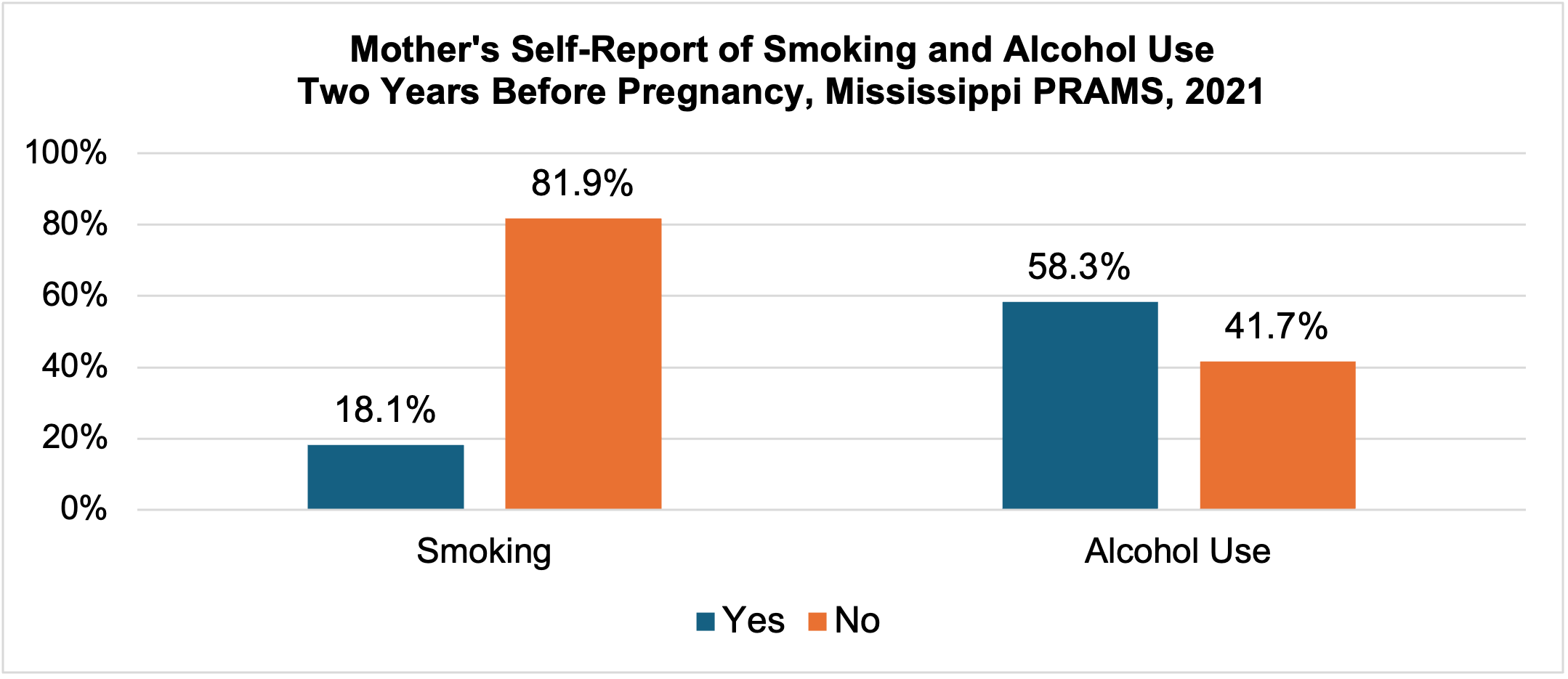
The figure below illustrates women who reported alcohol and/or cigarette use in the two years before pregnancy. There is a much higher percentage of alcohol use before pregnancy compared to cigarette use.
SUD: How are Providers Supporting Moms through Screening?
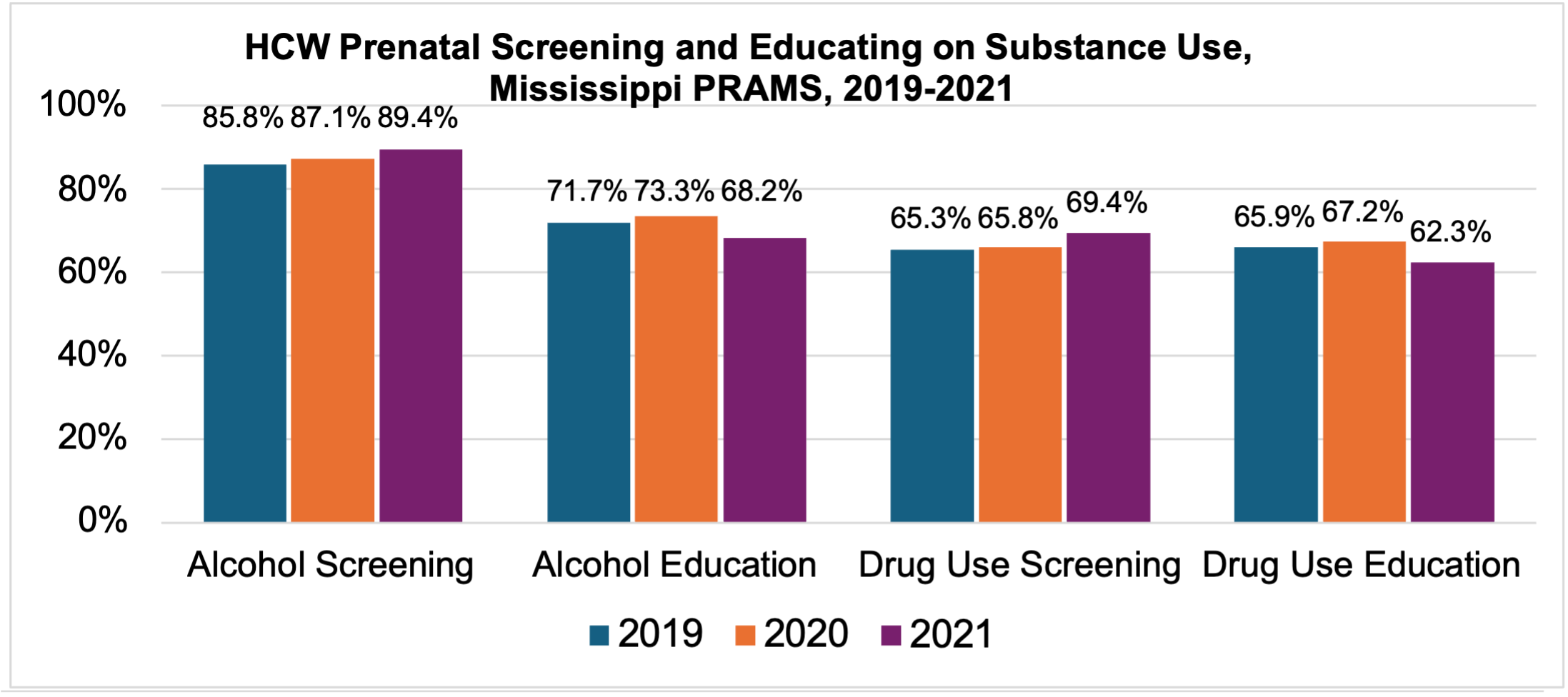
SUD Screening in Prenatal Care: The figure below illustrates how many women reported that their healthcare providers asked about their alcohol use and drug use (e.g., marijuana, cocaine, crack, or meth) during prenatal visits (%). Data for the years 2019, 2020, and 2021 are reported. While there is room for improvement when it comes to screening for alcohol use during pregnancy, there is a large gap when it comes to screening for drug use during pregnancy.
Less than 75% of mothers reported receiving education on alcohol and drug use during a prenatal care visit.
SUD: How are Providers Supporting Moms through Education?
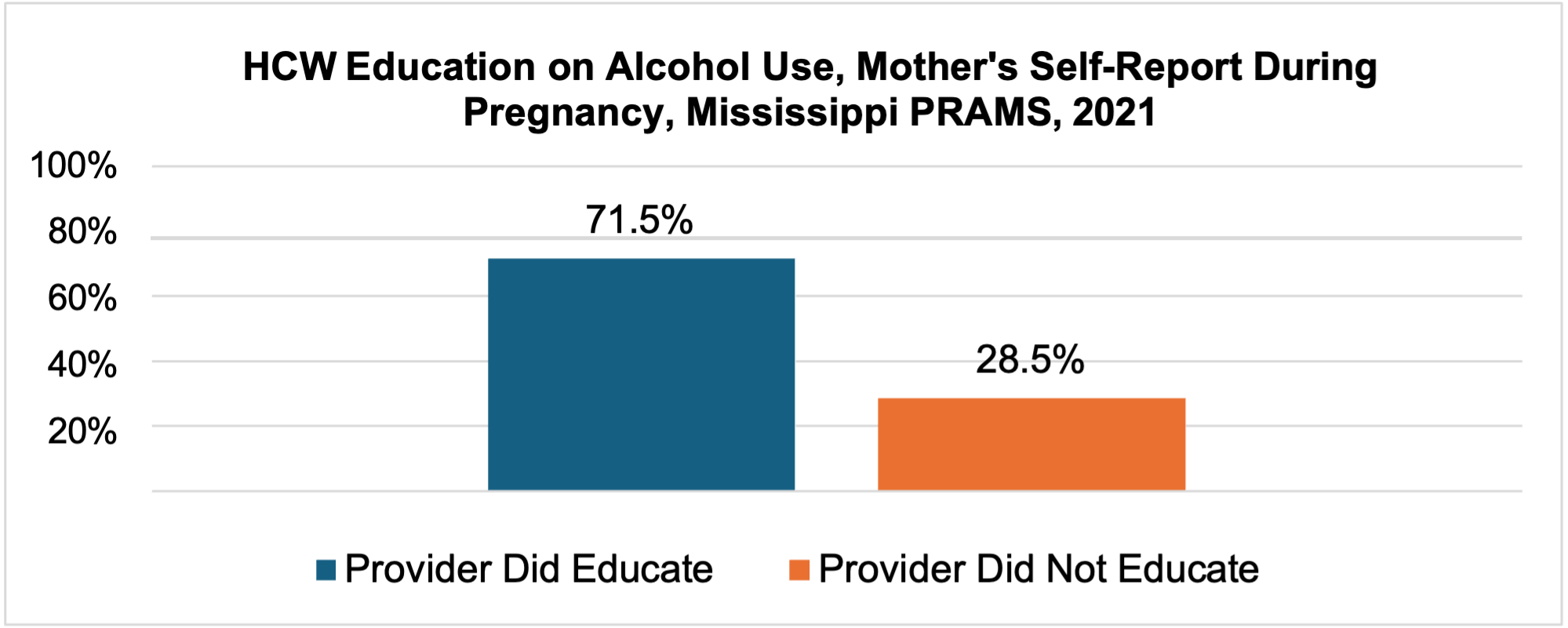
The below figure illustrates the percentage of mothers who reported that their healthcare providers discussed the effects of prenatal alcohol use on their baby.
INTIMATE PARTNER VIOLENCE (IPV)
Intimate Partner Violence (IPV) refers to harm done by a person's spouse or partner; this term is also used when harm is done by ex-spouses and ex-partners. 'Harm', in this context, includes physical, emotional, and sexual abuse (Abramsky et al., 2011; Stewart et al., 2013). Pregnant and postpartum women are even more vulnerable.
IPV: What are Mississippi Moms Experiencing?
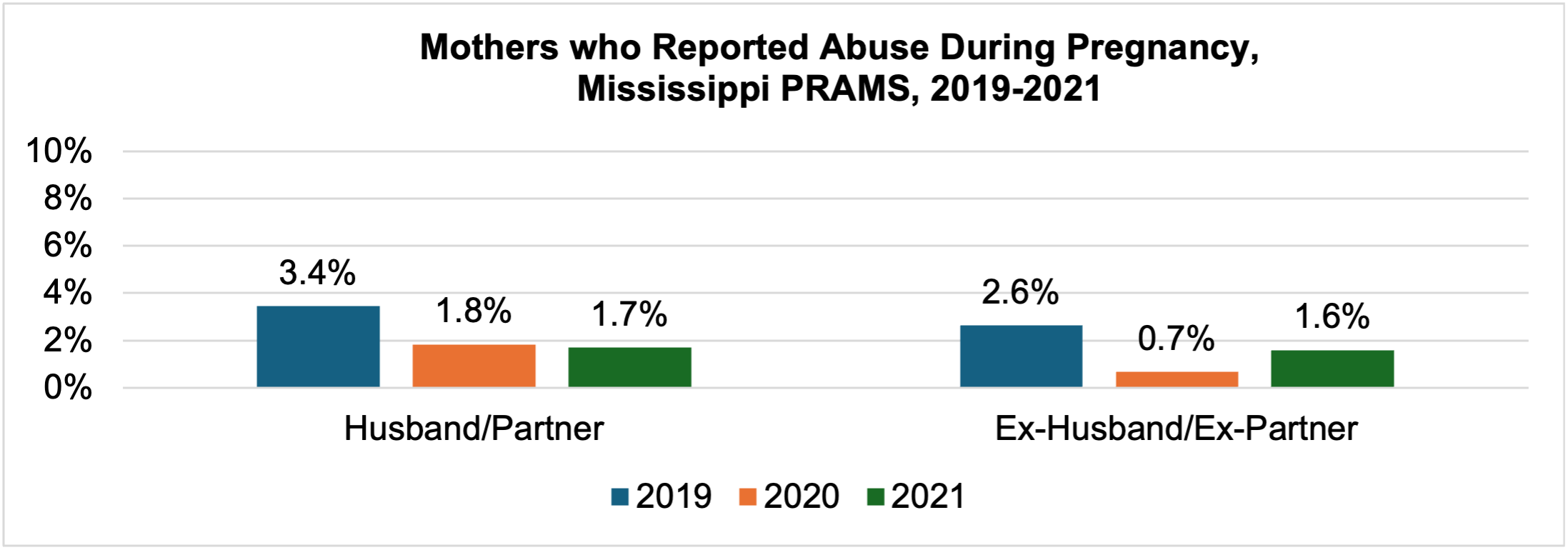
The figure below shows the percentage of Mississippi mothers who reported experiencing abuse during their pregnancy, either from their husband/partner or their ex-husband/ex-partner. Generally, it suggests that the rate at which mothers are experiencing IPV is decreasing over time.
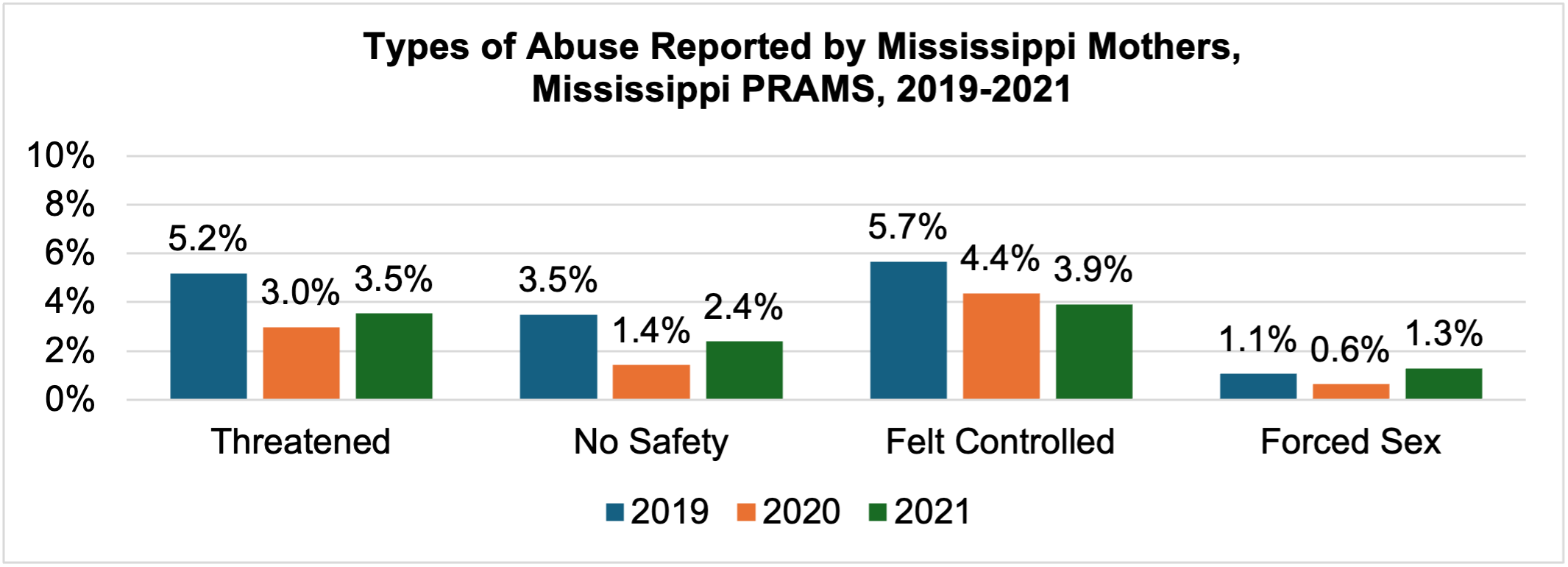
The figure below illustrates the rate at which Mississippi moms reported experiencing certain types of abuse from their husband/partner. Across the 3 reported years, 'feeling controlled' is the most common abusive behavior mothers report experiencing.
IPV: How are Providers Supporting Moms with Screening?
The figure below illustrates how many women reported that their healthcare providers screened them for physical or emotional abuse (%). Taken together, these figures suggest that Mississippi moms are being educated about IPV less than half of the time, and are screened for IPV slightly more than half of the time.

IPV: How are Providers Supporting Moms with Education?
The figure below illustrates how many women reported that their healthcare providers educated them about abuse from husbands/partners (%).

SUBSTANCE USE DISORDER (SUD) AND INTIMATE PARTNER VIOLENCE (IPV) DURING PREGNANCY
SUD & IPV: What is the Experience of Mississippi Moms?
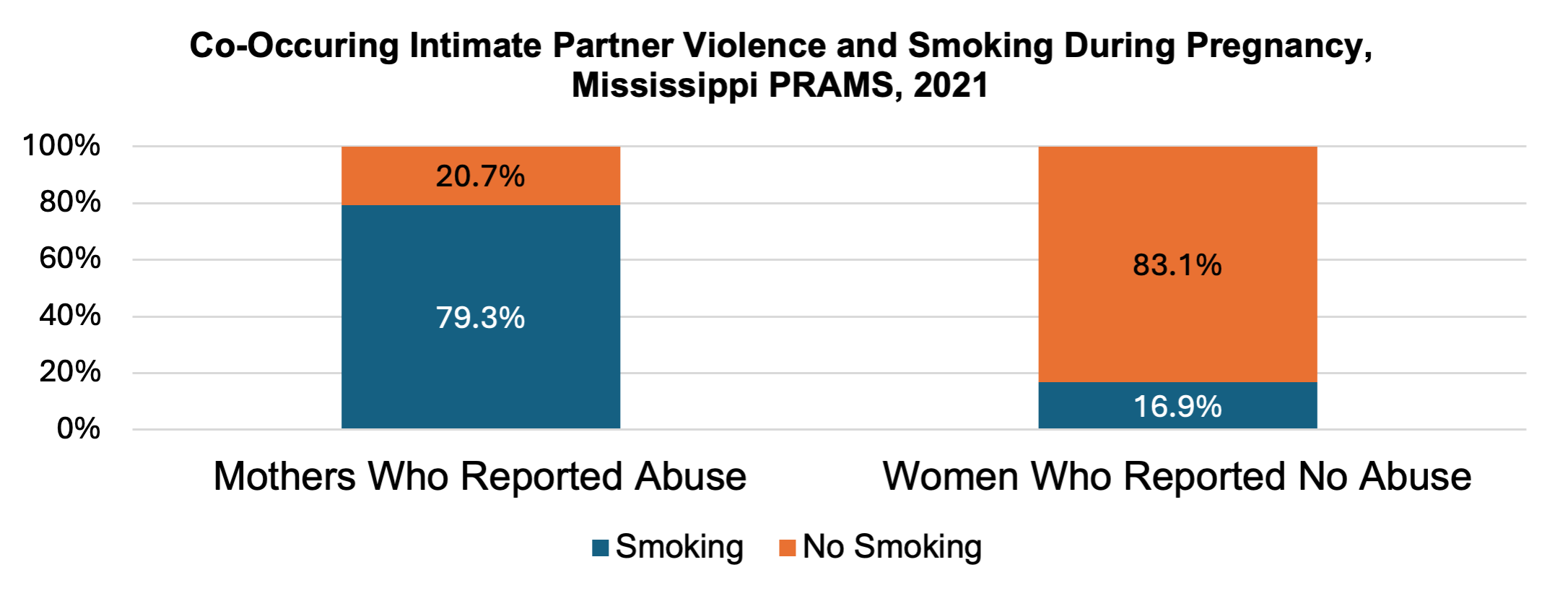
The figure below illustrates the rate at which Mississippi moms reported experiencing abuse from their husband/partner. Mothers who reported experiencing abuse from their husband/partner were much more likely to report smoking during pregnancy compared to mothers who reported no abuse.
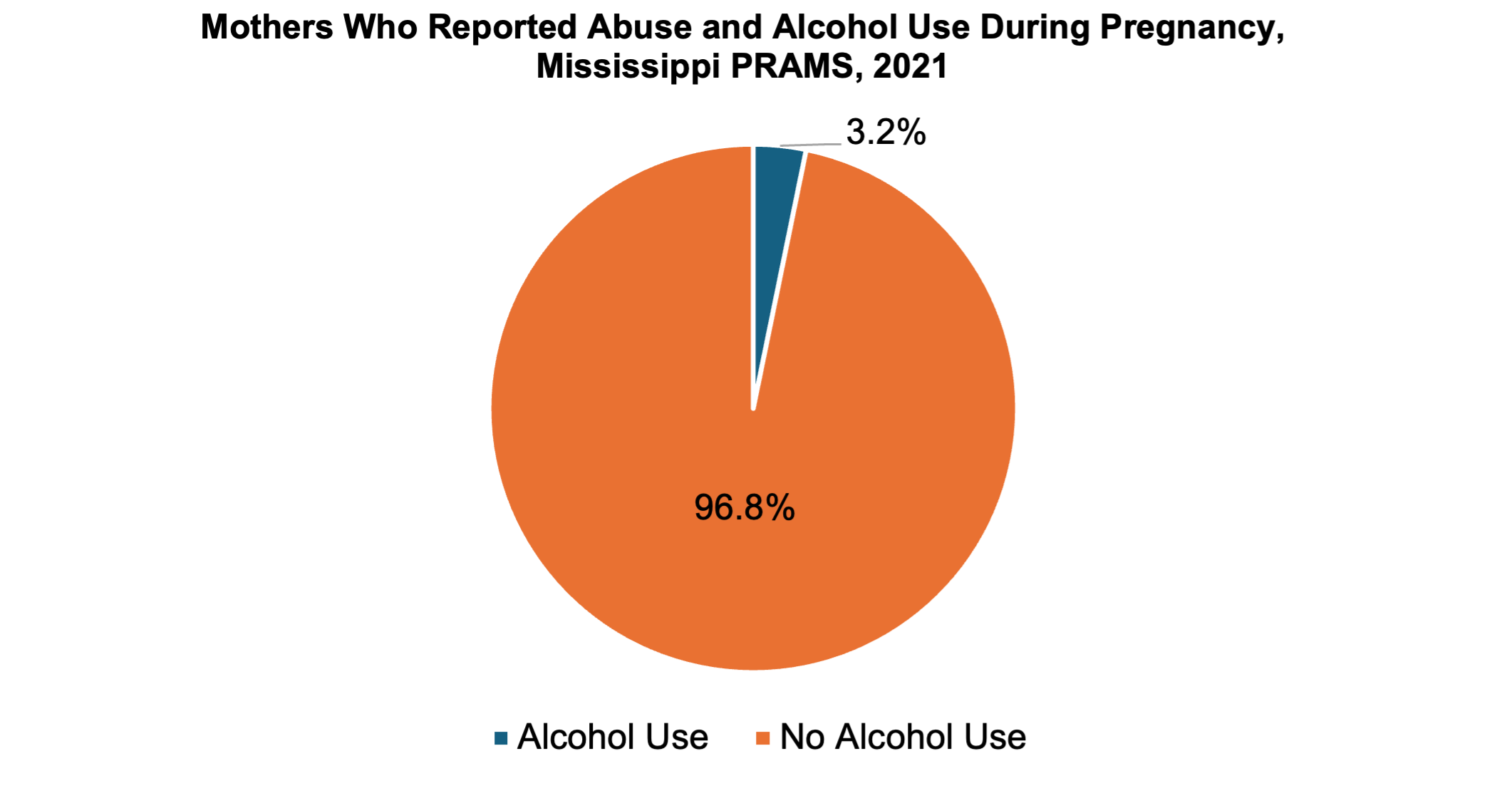
The below figure indicates that approximately 3.2% of mothers who reported experiencing IPV during pregnancy also reported alcohol use during pregnancy.
SUD AND IPV SCREENING AND EDUCATION DURING PREGNANCY SUD, IPV & MEDICAID STATUS
According to Mississippi PRAMS, across all three years examined, a majority of mothers reported that Medicaid was the servicer for their prenatal insurance.
Based on analyses examining differences in group means, the following patterns emerged regarding Medicaid status, SUD, and IPV.
SUD and Medicaid Status
- Significant differences in Medicaid Status and reported prenatal alcohol use. Mothers who had Medicaid for their prenatal care were slightly less likely to reportalcohol usecompared to mothers that did not have Medicaid for their prenatal care.
- Significant differences in Medicaid Status and HCW screening for prenatal alcohol Provider screening between the two groups was very similar, though mothers not on Medicaid were slightly more likely to be screened for alcohol usecompared to mothers that had Medicaid.
- Significant differences in Medicaid Status and HCW education for prenatal alcohol use. Providers were more likely to educate mothers who had Medicaidcompared to mothers who did not have Medicaid.
IPV and Medicaid Status
- Significant differences in Medicaid Status and reported IPV. Mothers who had Medicaid for their prenatal care reported experiencing abuse during pregnancy at aslightly higher ratecompared to mothers that did not have Medicaid for their prenatal care.
- Significant differences in Medicaid Status and HCW screening for IPV. Provider screening between the two groups was very similar, though mothers not on Medicaid were slightly more likely to be screened for IPVcompared to mothers that had Medicaid.
- Significant differences in Medicaid Status and HCW education for IPV. Providers were more likely to educate mothers who had Medicaidcompared to mothers who did not have Medicaid.
SUD, IPV & INCOME
Based on analyses examining differences in group means, the following patterns emerged regarding income, SUD, and IPV.
SUD and Income
- Significant differences in household income and reported prenatal alcohol use. Mothers who reported that they did use alcohol during pregnancy tended tohave higher reported incomesthan those who reported no alcohol use during pregnancy.
- Significant differences in household income and HCW screening for alcohol use. Mothers who reported that they were screened for prenatal alcohol use tendedto have higher reported incomescompared to mothers who were not screened.
- Significant differences in household income and HCW educating about alcohol use. Mothers who reported that they were educated about prenatal alcoholuse tended to have lower reported incomescompared to mothers who did not report receiving education.
IPV and Income
- Significant differences in household income and reported IPV during pregnancy. Mothers who reported that they did experience IPV during pregnancytended to have lower reported incomesthan those who reported no IPV during pregnancy.
- Significant differences in household income and HCW screening for IPV. Mothers who reported that they were screened for IPV tended to have lowerreported incomescompared to mothers who were not screened.
- Significant differences in household income and HCW educating about IPV. Mothers who reported that they were educated about prenatal IPV tended to havelower reported incomescompared to mothers who did not report receiving education.
SUD, IPV & MOTHER'S AGE
Based on analyses examining differences in group means, the following patterns emerged regarding mother's age, SUD, and IPV.
SUD and Mother's Age
- Significant differences in mother age and reported prenatal alcohol use. Mothers who reported that they did use alcohol during pregnancy were older, onaverage, than those who reported no alcohol use during pregnancy.
- Significant differences in mother age and HCW screening for alcohol use. Mothers who reported that they were screened for prenatal alcohol use wereyounger, on average, compared to mothers who were not screened.
- Significant differences in mother age and HCW educating about alcohol use. Mothers who reported that they were educated about prenatal alcohol usewere younger, on average, compared to mothers who did not report receiving education.
IPV and Mother's Age
- Significant differences in mother's age and reported IPV during pregnancy. Mothers who reported that they did experience IPV during pregnancy wereyounger, on average, than those who reported no IPV during pregnancy.
- Significant differences in mother's age and HCW screening for IPV. Mothers who reported that they were screened for IPV were younger, onaverage, compared to mothers who were not screened.
- Significant differences in mother's age and HCW educating about IPV. Mothers who reported that they were educated about prenatal IPV were younger,on average, compared to mothers who did not report receiving education. It is important to note that, while statistically significant, that these age differences were small.
Additional considerations - Pregnancy Associated Homicides. Based on the National Violence Death Reporting Systems at the Centers for Disease Control and Prevention (CDC), most pregnancy-associated homicides in multiple states were associated with firearm use (77%) and intimate partner violence (50%). The number of women killed in 2020 and 2021 in Jackson, Mississippi, has been the highest in more than two decades. It is important to note there is an unmet need for domestic violence support. According to the National Network to End Domestic Violence, in 2022, victims in Mississippi made 47 unmet requests for services that programs could not provide because they did not have the resources (17th Annual Domestic Violence Counts Report, 2023).
SECTION II - ADDRESSING THE PROBLEM
| KEY FINDINGS | RECOMMENDATIONS |
| There are inconsistencies in screening and educating about the same issue (e.g., screening for alcohol use and educating for alcohol use at the same rate). | Providing both screening and education to mothers for substance use disorder (SUD) and intimate partner violence (IPV) should be considered best practice. It might be that, for example, providers may assume that if a patient tells them they are not consuming alcohol education is not necessary. However, some mothers may be hesitant to report SUD/IPV during screening for various reasons. It is important for moms to understand risks and/or learn about resources which may lead to additional disclosures, allowing the provider to administer the best care and support. |
| Inconsistent screening and education leads to missed opportunities to support mothers. | Consistently screening and educating every patient is crucial for upholding standards of care.Mothers experiencing SUD may not be aware of the risks and may not be aware that they should bring this up with their provider.Additionally, mothers experiencing IPV may not be aware that their prenatal care provider is a resource who can connect them to other support systems. |
| Mothers experiencing intimate partner violence do appear to be at greater risk for substance use. | Again, consistency is key – screening for and educating about both substance use and IPV is critical to understanding the complex experiences of a patient and how to best serve them. |
SECTION III – IMPROVING THE PROBLEM: PROJECT WORK
PROJECT IMPLEMENTATION & ACTIVITIES. Our project trained providers to screen pregnant and postpartum women for Substance Use Disorder (SUD) and Intimate Partner Violence (IPV). Our activities included designing, implementing, and evaluating pilot training. We sought to improve IPV and SUD screening practices among providers. The team engaged community members to disseminate the training materials, increase provider knowledge, and promote routine screening practices for IPV and SUD.
INTENDED OUTCOMES AND IMPACT. Our intended outcome for the grant activities is to train providers in IPV and SUD screening and increase provider screening of women. The intended impact is to identify, contextualize, and decrease co-occurring SUD and IPV among pregnant and postpartum women in Mississippi. W hope our work informs Mississippi state agencies and Mississippi legislators in supporting pregnant and postpartum women experiencing substance use disorder and intimate partner violence.
CLIENT / PEER / PARTNER INVOLVEMENT. Our partner involvement included virtual and in-person opportunities for feedback from academic partners and trainees, as well as stakeholder engagement with organizations that work clients, peers and families.
These partners were critical to informing our work. We welcome continued from all partners in the future.
MEASUREMENT & EVALUATION. To assess outcomes of increased training and practice of screening for co-occurring IPV and SUD, the project's monitoring and evaluation team examined progress. Staff members assessed data from SUD/IPV training participants at pre and post-training time points, provided periodic reports based on the surveys, and discussed the findings to increase knowledge, identify gaps, and inform planning. To monitor changes over time, we can measure progress by utilizing public health surveillance systems (e.g. Mississippi Pregnancy Risk Assessment Monitoring System, PRAMS) and statewide public health reports for population health and maternal health (e.g. Mississippi Maternal Mortality Report).
SUSTAINABILITY. Our work's long term sustainability efforts were informed by evaluating our activities, understanding organizational capacity, and utilizing stakeholder engagement. We have pilot training data that can be used for planning, and we will continue quality improvement efforts to address the sustainability of this work.
Publications and Works
Podium Presentations
- Karimi, M., Morris, M., Dehon, E., Voluse, A., Brassfield, M., Lahn, D., Poehling, C., Kolbo, J., Zhang, S., Wesley, M., Price, T., Slade, L., Howington, D., Rhodes, K., Davis, T., Fuqua, S., Johnson, V., Gordy, X., Zhang, L. (November 2025). Enhancing Screening and Referral for Intimate Partner Violence (IPV) and Substance Use Disorder (SUD) Among Pregnant and Postpartum Women in Mississippi, American Public Health Association Annual Meeting and Expo. 2025, Washington D.C., United States.
APPENDIX
REFERENCES
Abramsky, T., Watts, C. H., Garcia-Moreno, C., Devries, K.,Kiss, L., Ellsberg, M., ... & Heise, L. (2011). What factors are associated with recent intimate partner violence? Findings from the WHO multi-country study on women's health and domestic violence. BMC public health, 11(1), 109.
Mason, R., & O'rinn, S. E. (2014). Co-occurring intimate partner violence, mental health, and substance use problems: a scoping review. Global health action, 7(1), 24815.
Ogden, S. N., Dichter, M. E., & Bazzi, A. R. (2022). Intimate partner violence as a predictor of substance use outcomes among women: A systematic review. Addictive behaviors, 127, 107214.
Stewart, D. E., MacMillan, H., & Wathen, N. (2013). Intimate partner violence. The Canadian Journal of Psychiatry, 58(6), E1-E15.
Volkow, N. D., & Blanco, C. (2023). Substance use disorders: a comprehensive update of classification, epidemiology, neurobiology, clinical aspects, treatment and prevention. World psychiatry : official journal of the World Psychiatric Association (WPA), 22(2), 203–229. https://doi.org/10.1002/wps.21073
DEMOGRAPHICS
Mississippi Pregnancy Risk Assessment Monitoring System (PRAMS)
| 2019 | 2020 | 2021 | ||||
| N | % | N | % | N | % | |
| Age | ||||||
| <19 | 2,610 | 7.7% | 2,749 | 8.3% | 2,562 | 7.9% |
| 20-24 | 9,303 | 27.3% | 9,451 | 28.7% | 8,510 | 26.3% |
| 25-29 | 10,828 | 31.8% | 10,391 | 31.6% | 10,508 | 32.4% |
| 30-34 | 7,916 | 23.3% | 7,223 | 21.9% | 7,624 | 23.5% |
| 35+ | 3,380 | 4.9% | 3,113 | 9.5% | 3,196 | 9.9% |
| Total | 34,036 | 32,928 | 32,400 | |||
| Race | ||||||
| White | 16,846 | 49.5% | 17,379 | 52.8% | 16,378 | 50.5% |
| Black | 14,997 | 44.1% | 13,301 | 40.4% | 13,521 | 41.7% |
| Other Races | 2,193 | 6.5% | 2,249 | 6.8% | 2,501 | 7.7% |
| Total | 34,036 | 32,928 | 32,400 | |||
| Education | ||||||
| Less than High School | 4,339 | 12.8% | 3,960 | 12.0% | 3,736 | 11.5% |
| High School | 10,077 | 29.6% | 10,414 | 31.6% | 10,446 | 32.2% |
| Some College | 11,779 | 34.6% | 11,274 | 34.2% | 10,318 | 31.9% |
| College Graduate | 7,827 | 23% | 7,281 | 22.1% | 7,889 | 24.4% |
| Missing | 14 | 0% | - | - | 10 | 0% |
| Total | 34,036 | 32,928 | 32,400 | |||
| Income | ||||||
| $0 - $16,000 | 10,496 | 32.9% | 7,464 | 22.7% | 8,253 | 25.5% |
| $16,001 - $32,000 | 8,669 | 27.4% | 9,634 | 29.3% | 8,139 | 25.2% |
| $32,001 - $60,000 | 6,359 | 20.0% | 5,879 | 17.9% | 6,234 | 19.2% |
| $60,001-$85,000 | 2,326 | 7.3% | 2,926 | 8.9% | 2,420 | 7.5% |
| $85,001 or more | 4,038 | 12.7% | 4,493 | 14.6% | 3,754 | 11.6% |
| Missing | 2,147 | 6.3% | 2,532 | 7.7% | 3,600 | 11.1% |
| Total | 34,035 | 32,928 | 32,400 | |||
| Data Inventory for Substance Use Disorder & Intimate Partner Violence | ||
| Source | What is it? | Webpage Links |
| Mississippi Pregnancy Risk Assessment Monitoring System (MS PRAMS) | MS PRAMS is a state-based surveillance system collecting data on maternal attitudes, experiences, and behaviors before, during, and shortly after pregnancy. | State Data: https://msdh.ms.gov/page/31,0,301.html |
| Behavioral Risk Factor Surveillance System (BRFSS) | A nationwide, state-level health survey collecting data on health-related risk behaviors, chronic diseases, and preventive health practices among U.S. adults. | National and State Data: https://www.cdc.gov/brfss/index.html https://msdh.ms.gov/page/31,0,110.html |
| Youth Risk Behavior Surveillance System (YRBSS) | YRBSS monitors health-related behaviors among high school students, focusing on behaviors contributing to the leading causes of death and disability in youth and adults. | National and State Data: https://www.cdc.gov/yrbs/index.html https://msdh.ms.gov/page/31,0,302.html |
| National Violent Death Reporting System (NVDRS) | A nationwide, state-based system that collects and links data on violent deaths (homicides, suicides, unintentional firearm deaths, legal intervention deaths) from multiple sources. | National Data: https://www.cdc.gov/nvdrs/about/index.html |
| Mississippi Violent Death Reporting System (MS-VDRS) | A state-level component of the NVDRS, collecting and analyzing violent death data specific to Mississippi. | State Data: https://msdh.ms.gov/page/31,0,421.html |
| Mississippi Maternal Mortality Review Committee (MMRC) | A state-based multidisciplinary committee that reviews maternal deaths to determine causes, contributing factors, and preventability. | Data Overview: https://www.cdc.gov/maternal-mortality/php/mmrc/index.html |