


Publications and Works
Substance Use Disorders (SUD) and Intimate Partner Violence (IPV) Among Mississippi's Moms: Initiative to Prevent and Treat – Data Brief
Project Background: The SIMM Initiative is a project focused on increasing screening for Mississippi's pregnant and postpartum women at risk for co-occurring SUD and IPV. This work is supported by WH-AST-22-004 Violence Against Women and Substance Use Prevention Initiative.
Select a topic to jump to a section.
INTRODUCTION
- It is estimated that the co-occurrence of substance use/abuse and IPV is between 20% and 57% for S. women enrolled in substance use intervention programs (Mason & O'rinn 2014).
- In the context of pregnant and postpartum women, co-IPV and SUD can be barriers to disclosure and care (Ogden, Dichter, and Bazzi, 2022).
SUBSTANCE USE DISORDER (SUD)
- Substance Use Disorder (SUD) refers to recurring use of drugs (e.g., alcohol, tobacco, controlled substances, prescription medication, etc.) that negatively impacts an individual's day-to-day living and/or physical or mental health.
- In the case of SUD, the substance often takes priority over things like personal care, relationships, and job obligations, and it is often very challenging to end the cycle of use due to the addictive nature of some of these substances (Volkow & Blanco, 2023).
- Some risks associated with substance use include reckless behavior, altered state of mind, and
INTIMATE PARTNER VIOLENCE (IPV)
- Intimate Partner Violence (IPV) refers to harm done by a person's spouse or partner; this term is also used when harm is done by ex-spouses and ex-partners.
- ‘Harm', in this context, includes physical, emotional, and sexual abuse (Abramsky et al, 2011; Stewart et al., 2013). Pregnant and postpartum women are even more vulnerable.
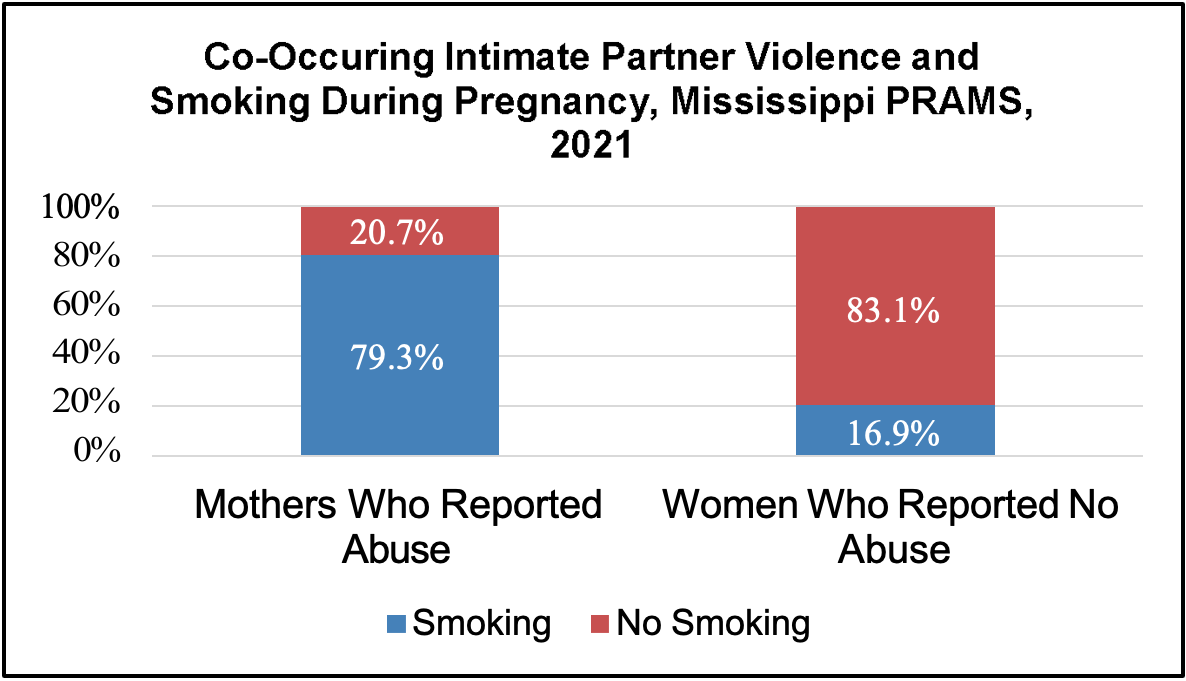
This figure illustrates the rate at which Mississippi moms reported experiencing abuse from their husband/partner. experiencing abuse from their husband/partner were much more likely to pregnancy compared to mothers who reported no abuse.
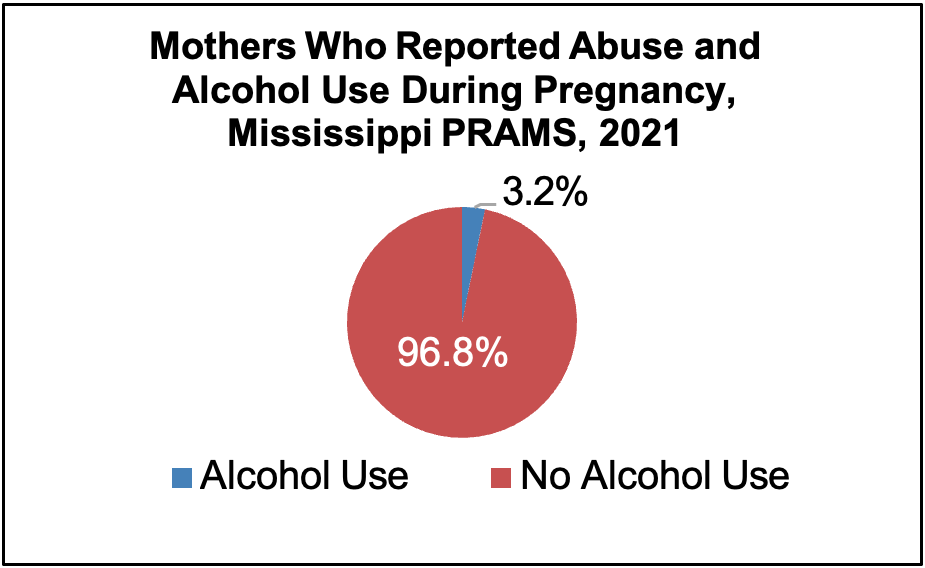
This figure indicates that approximately 3.2% of mothers who reported experiencing IPV during pregnancy also reported alcohol use during pregnancy.
KEY FINDINGS
- Mothers experiencing intimate partner violence appear to have greater chance for substance use.
- There are inconsistencies in screening and educating practices that lead to missed opportunities for pregnant and postpartum women, raising a concern about vulnerable populations.
RECOMMENDATIONS
- We recommend providers screen and educate mothers for substance use disorder and intimate partner violence as a best practice in understanding a mother's complex pregnancy and postpartum experience.
- Consistent screening and education will uphold a high standard of care to best serve pregnant and postpartum women in Mississippi.
REFERENCES
Abramsky, T., Watts, C. H., Garcia-Moreno, C., Devries, K.,Kiss, L., Ellsberg, M., ... & Heise, L. (2011). What factors are associated with recent intimate partner violence? Findings from the WHO multi-country study on women's health and domestic violence. BMC public health, 11(1), 109.
Mason, R., & O'rinn, S. E. (2014). Co-occurring intimate partner violence, mental health, and substance use problems: a scoping review. Global health action, 7(1), 24815.
Ogden, S. N., Dichter, M. E., & Bazzi, A. R. (2022). Intimate partner violence as a predictor of substance use outcomes among women: A systematic review. Addictive behaviors, 127, 107214.
Stewart, D. E., MacMillan, H., & Wathen, N. (2013). Intimate partner violence. The Canadian Journal of Psychiatry, 58(6), E1-E15.
Volkow, N. D., & Blanco, C. (2023). Substance use disorders: a comprehensive update of classification, epidemiology, neurobiology, clinical aspects, treatment and prevention. World psychiatry : official journal of the World Psychiatric Association (WPA), 22(2), 203–229. https://doi.org/10.1002/wps.21073