


Treatment
Epilepsy surgery
Surgery for diagnosis
Invasive EEG monitoring (Phase II)
Sometimes, continuous EEG monitoring does not provide enough information for physicians to determine the precise area within the brain where seizures originate. When this happens, some patients may be candidates for surgical testing in a procedure called SEEG or stereotactic EEG.
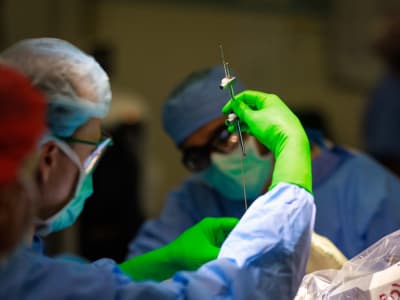
During robot-assisted surgery, electrodes are implanted deep into the brain in the area where seizures seem to originate. Following surgery, patients are admitted to the ICU and seizure medications are discontinued. In the controlled environment of the ICU, the epilepsy team can monitor the surgically-implanted electrodes to determine if the area of the brain where seizures originate can be confirmed. After the testing is completed, the patient returns to surgery to remove the electrodes, then discharge to home, back on their medications.
Surgery for treatment
Patients, both adults and children, who continue to have seizures after having tried at least two different epilepsy medications, correctly prescribed and dosed, are diagnosed with medically intractable epilepsy. These patients may be helped by surgery.
UMMC’s epilepsy program conducts weekly presurgical epilepsy conferences to discuss patient cases. There are separate conferences for pediatric and adult patients. Participating representatives include:
- Neurology (epileptologists)
- Neurophysiologists
- Neurosurgery
- Radiology
- Neuropsychology
- Neurophysiology technologists
- Pediatric specialists in all the above disciplines
These experts discuss all aspects of a patient’s condition and test results. As a group, they reach consensus about whether or not surgery can be performed successfully with good outcomes. When the group agrees that surgery is an option, there are several types of surgery that are available:
- Resection: In this surgery, the part of the brain where seizures originate is removed.
- Disconnection: In this technique, surgeons disconnect nerve pathways that tie the epileptogenic region of the brain, the area where seizures originate, to the rest of the brain.
- Ablation: Using a technique called laser interstitial thermal therapy (LITT), surgeons use a laser to destroy cells in the epileptogenic region of the brain.
- Neuromodulation. In this procedure, the surgeon implants a pacemaker-type device into the body to manipulate and modify the seizure network in the brain. Techniques include:
- Responsive neurostimulation (RNS): This therapy may help people with focal medically intractable epilepsy. The device is implanted into the skull below the scalp with extremely small leads implanted to the area of the brain where seizures start. The device can be removed if needed or desired. It recognizes seizure activity and acts to prevent them. It also records and reports EEG data to the patient’s doctor.
- Deep brain stimulation (DBS): This therapy is FDA approved for patients at least 18 years old. It is an option for people with focal seizures. The DBS device is surgically implanted under the skin into the chest or abdomen. Leads, which are thin, insulated wires, connect to the device and to the area in the brain where seizures start. After being programmed by the doctor to the patient’s specific needs, it provides controlled electrical stimulation to the targeted area. The device is compatible with MRI testing.
- Vagus nerve stimulation (VNS): This type of therapy is approved for people 4 years old and up to treat focal or partial seizures. A device is surgically implanted under the skin into the left chest. A lead from the device is attached to or wrapped around the vagus nerve in the neck. It sends electrical pulses at regular intervals to the brain to help regulate brain activity.
The neurosurgeon will recommend the type of procedure that matches the patient’s specific situation for the best possible outcome.