Spring Update
Good morning!
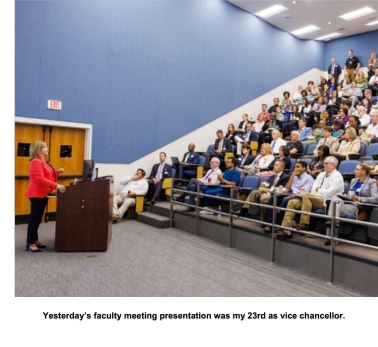
It was wonderful to see a full house at the spring faculty meeting yesterday. For those who were unable to attend in person or online, I’m sharing a few highlights from my presentation, which are good for the entire Medical Center community to know.
 I addressed a topic that has understandably been top of mind for all of us: the unprecedented cyberattack on Feb. 19 that disrupted our operations – but did not stop us.
In the early hours of that morning, our systems detected irregular activity. At the same time, multiple users began reporting issues. It quickly became clear this was not an isolated problem, and a critical decision was made to shut down affected systems to contain the threat. By Saturday, Feb. 28, we were largely back to normal – significantly faster than the national average for recovery from similar incidents.
Let me be clear about a few important points:
- This was not the result of a single user error or someone clicking on a malicious email.
- Our monitoring systems worked as designed.
- Our teams responded quickly, appropriately and in coordination.
- The threat actor is well known to the FBI.
While the immediate crisis has passed, the work is not fully complete. We are continuing detailed forensic analysis to determine what data was accessed or exfiltrated, and we will meet all regulatory and reporting requirements. This process takes time.
What this experience reinforced, however, is something very important: preparedness matters. Across clinical care, education, research and operations, people stepped up. Care continued. Students continued training. This is what institutional resilience looks like.
That same sense of alignment and shared responsibility is reflected in how we approach our broader institutional priorities.
We are now fully operating under our 2030 strategic plan. Our priorities remain consistent:
- Quality of care
- Clinical access, efficiency and growth
- Academic excellence
- Research strength
- Service optimization
What is changing is the scale and urgency of execution. Every department, unit and individual should be able to clearly connect their work to one or more of these priorities.
Through January, we were performing in line with budget expectations, driven largely by strong patient care revenue. The cyberattack did create disruption – delayed procedures, rescheduled visits and operational challenges – but even with broader economic pressures, we expect to remain close to our projected targets.
This reinforces a fundamental truth about our institution: Our financial strength is directly tied to the quality of care we provide and that our patients have an excellent experience.
The Cancer Center and Research Institute remains one of our most important strategic priorities.
We are making meaningful progress through:
- Ongoing faculty recruitment
- Expansion of clinical trials
- Building a world-class home for all our cancer programs
- Strong philanthropic momentum
Achieving National Cancer Institute designation remains a priority. Under the leadership of Dr. Rod Rocconi, Ergon Chair for Cancer Research and CCRI director, this work will have a transformative impact on our institution and our state for generations.
We continue to see positive movement at both the federal and state government levels:
Federal: Continued strong support for NIH, NCI and other grant-making agencies, including investments in primary care residency, obesity prevention and telehealth. Congress also directed money to UMMC for the new cancer facility site prep and for renovation of labs in the Research Wing.
State: The FY27 legislative appropriations bill includes level institutional funding of approximately $190 million and level funding of our line-item programs. Additionally, our $100 million request for the Cancer Center received strong support, passed both chambers and is awaiting signature from the Governor.
Philanthropy continues to play a critical role in our progress. Through our “It’s About Time” campaign to fund the construction of a cancer facility, we have raised $100 million of our $125 million goal – well ahead of schedule.
We are deeply grateful to our donors and to the Office of Development and Alumni Engagement for its continued success in advancing our mission.
Student enrollment continues to grow across our schools. At the same time, our focus remains firmly on educational quality, accreditation readiness and student outcomes. We are an academic institution, and we will never veer far from our core mission to train Mississippi’s health care professionals.
Key milestones ahead include:
- Opening of the new School of Nursing building later this year
- Opening of the new clinical School of Dentistry building, with completion expected in 2027
We also celebrate recent clinical and operational growth, including:
- Opening of Colony Park North
- Launch of the Adolescent Acute Psychiatric Unit
These developments expand both our capacity and our ability to meet the needs of our patients and communities.
This year has been a year of challenge, but even more so, a year of progress.
We have adapted; we have grown; and we are positioned to do even more. The work ahead is important – and the opportunity before us is even greater.
Thank you for everything you do to support this institution and the people we serve.
Together, we are moving toward A Healthier Mississippi.